

All France News
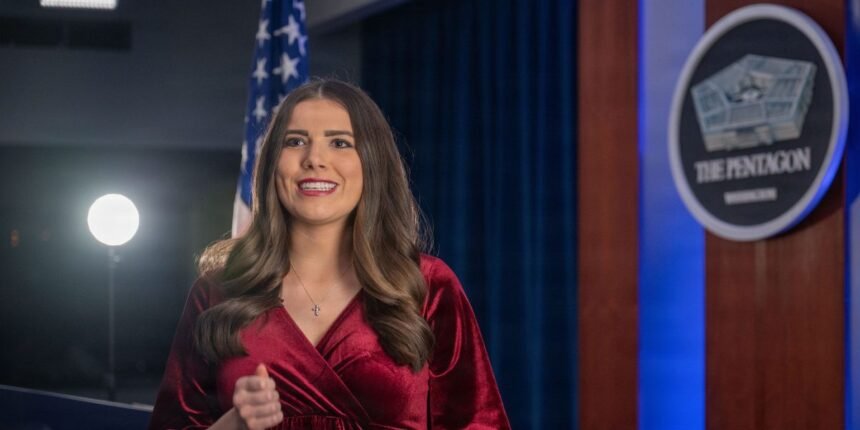
After Pentagon press secretary Kingsley Wilson declared the War Department was certain about the identities of supposed drug smugglers killed in boat strikes, Rep. Chrissy Houlahan, D-Pa., had some questions about the intelligence. When Houlahan called on Wilson to appear before Congress, however, the outspoken and controversial spokesperson suddenly went silent.
“I can tell you that every single person who we have hit thus far who is in a drug boat carrying narcotics to the United States is a narcoterrorist. Our intelligence has confirmed that, and we stand by it,” Wilson said on Tuesday during a pseudo Pentagon press briefing where attendance was limited to media outlets that have agreed to limits on the scope of their reporting.
“Our intelligence absolutely confirms who these people are,” she said. “I can tell you that, without a shadow of a doubt, every single one of our military and civilian lawyers knows that these individuals are narcoterrorists.”
In exclusive comments to The Intercept, Houlahan expressed her doubts and demanded proof.
“If there is intelligence that ‘absolutely confirms’ this — present it. Come before the House or Senate Intelligence committees and let Congress provide the proper oversight and checks and balances the American people deserve,” said Houlahan, who serves on the House Armed Services Committee and the House Permanent Select Committee on Intelligence. “Put the whispers and doubts to rest once and for all. If there is intelligence to ‘absolutely confirm’ this, the Congress is ready to receive it. Until we all see it, you can surely understand why we are skeptical.”
Both the House Armed Services Committee and the House Permanent Select Committee on Intelligence, both of which Houlahan serves on, routinely receive classified briefings from the military.
Wilson — who touted a “new era” of working to “keep the American people informed and to ensure transparency” on Tuesday — did not respond to questions or requests for comment from The Intercept about Houlahan’s remarks or appearing before Congress.
In past classified briefings to lawmakers and congressional staff, the military has admitted that it does not know exactly who it’s killing in the boat strikes, according to seven government officials who have spoken with The Intercept.
Rep. Sara Jacobs, D-Calif., also a member of the House Armed Services Committee, said that Pentagon officials who briefed her admitted that the administration does not know the identities of all the individuals who were killed in the strikes.
“They said that they do not need to positively identify individuals on the vessels to do the strikes,” Jacobs told The Intercept in October. “They just need to show a connection to a DTO or affiliate,” she added, using shorthand for “designated terrorist organizations,” the Trump administration’s term for the secret list of groups with whom it claims to be at war.
Twenty-One Attacks
The military has carried out 21 known attacks, destroying 22 boats in the Caribbean Sea and eastern Pacific Ocean since September and killing at least 83 civilians. It has not conducted a strike on a vessel since November 15.
Since the strikes began, experts in the laws of war and members of Congress from both parties say the strikes are illegal extrajudicial killings because the military is not permitted to deliberately target civilians — even suspected criminals — who do not pose an imminent threat of violence.
The summary executions mark a major departure from typical practice in the long-running U.S. war on drugs, where law enforcement agencies arrest suspected drug smugglers.
A double-tap strike during the initial September 2 attack — where the U.S. hit an incapacitated boat for a second time, killing two survivors clinging to the wreckage — added a second layer of illegality to strikes that experts and lawmakers say are already tantamount to murder. The double-tap strike was first reported by The Intercept.
War Secretary Pete Hegseth has been under increasing fire for that strike. The Washington Post recently reported that Hegseth personally ordered the follow-up attack, giving a spoken order “to kill everybody.”
Hegseth acknowledged U.S. forces conducted a follow-up strike on the alleged drug boat during a Cabinet meeting at the White House on Tuesday but distanced himself from the killing of people struggling to stay afloat.
“I didn’t personally see survivors,” Hegseth told reporters, noting that he watched live footage of the attack. “The thing was on fire. It was exploded in fire and smoke. You can’t see it.”
He added, “This is called the fog of war.”
Hegseth said Adm. Frank M. Bradley, then the commander of Joint Special Operations Command and now head of Special Operations Command, “made the right call” in ordering the second strike, which the war secretary claimed came after he himself left the room. In a statement to The Intercept earlier this week, Special Operations Command pushed back on the contention that Bradley ordered a double-tap attack.
“He does not see his actions on 2 SEP as a ‘double tap,’” Col. Allie Weiskopf, the director of public affairs at Special Operations Command, told The Intercept on Tuesday.
Bradley and Gen. Dan Caine, the chair of the Joint Chiefs of Staff, are slated to go to Capitol Hill on Thursday to answer questions about the attack amid an ongoing uproar. Congressional staffers say that Bradley is currently slated to only meet with House Armed Services Committee Chair Mike Rogers, R-Ala., and ranking member Rep. Adam Smith, D-Wash., along with the Senate Armed Services Committee Chair Roger Wicker, R-Miss., and ranking member Sen. Jack Reed, D-R.I.
“The Seditious Six”
Houlahan was one of six Democratic members of Congress who appeared in a video late last month reminding members of the military of their duty not to obey illegal orders. President Donald Trump called for the group to face arrest and trial or even execution, saying the video amounted to “SEDITIOUS BEHAVIOR FROM TRAITORS.”
Wilson, during her faux press briefing — delivered to mostly administration cheerleaders after outlets from the New York Times to Fox News relinquished their Pentagon press passes rather than agree to restrictions that constrain reporters’ First Amendment rights — called out Houlahan and her fellow lawmakers in the video.
“[T]he Seditious Six urged members of our military to defy their chain of command in an unprecedented, treasonous and shameful conspiracy to sow distrust and chaos in our armed forces,” said Wilson. She went on to call the video “a politically motivated influence operation” that “puts our warfighters at risk.”
Hegseth described the members of Congress’s video as “despicable, reckless, and false.” Hegseth himself, however, had delivered a similar message recorded in 2016 footage revealed by CNN on Tuesday.
Wilson did not reply to a request for comment about Hegseth’s remarks.
Hegseth is also in the hot seat after the Pentagon Inspector General’s Office determined that he risked the safety of U.S. service members by sharing sensitive military information on the Signal messaging app, according to a source familiar with the forthcoming report by the Pentagon watchdog.
The report, which is expected to be released on Thursday, was launched after a journalist at The Atlantic revealed he had been added to a chat on the encrypted messaging app, in which Hegseth and other top officials were discussing plans for U.S. airstrikes in Yemen that also killed civilians.