

All France News
Former Minnesota state Sen. Matt Little was lawfully observing federal immigration agents in a Dakota County neighborhood last month when the drive took an unexpected turn.
As he followed their vehicles, they led him down a rural road that grew increasingly familiar during the 20-minute drive. Soon, Little told The Intercept, he realized where the federal agents were headed: his house.
When he approached his driveway, two SUVs were already waiting, Little said. Agents moved to block his car, claiming he had impeded their investigation and that local law enforcement would be called. No other officers came to his house, and Little was not cited or charged.
“The intent was clearly to intimidate us. It’s stressful. It’s a little bit scary. But at the same time,” Little said, “I just think it’s really important to be out there and monitoring what they’re doing.”
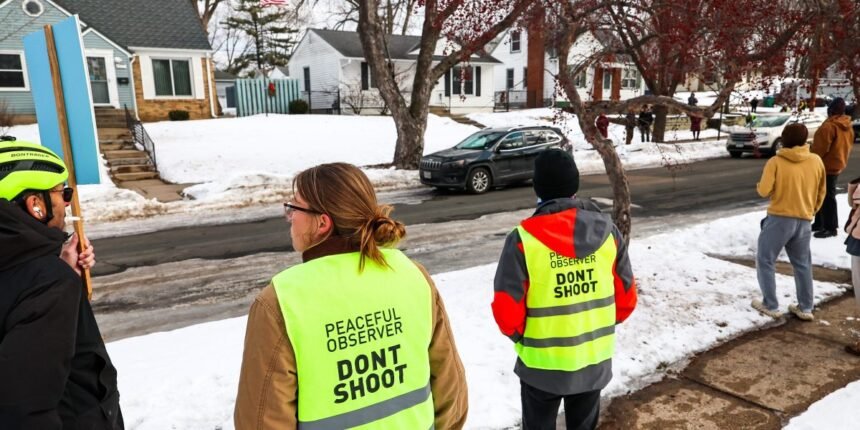
Interviews, sworn declarations, and video reviewed by The Intercept indicate that Little is not the only person subjected to this kind of intimidation. Across the Twin Cities, immigration agents have identified legal observers by name and address, and, in some cases, led them back to their homes after they engaged in lawful monitoring of immigration activity. Legal observers say this pattern of behavior sends a clear and chilling message: The federal government knows who they are and where they live.
These encounters are unfolding amid a rapid expansion of federal surveillance capabilities.
Immigration authorities have significantly expanded their use of mobile biometric and surveillance tools in recent years. Officers with Immigration and Customs Enforcement as well as Customs and Border Protection, for example, can use the smartphone app Mobile Fortify to photograph a person’s face or capture fingerprints in the field and compare them against federal biometric databases, according to a Department of Homeland Security inventory of artificial intelligence technologies.
“We make sure to lock the door now.”
Those tools operate within a broader surveillance infrastructure that includes automated license plate readers, commercial data brokers, and face recognition systems. A 2022 report from Georgetown Law’s Center on Privacy and Technology found ICE can access driver’s license data covering roughly three-quarters of U.S. adults, including state photo databases that can be searched using face recognition technology.
Civil liberties advocates say the growing web of identification tools has enabled federal agents to quickly identify anyone who monitors or protests their actions — chilling protected First Amendment activity and deterring the legal observation of law enforcement.
“We make sure to lock the door now,” said Little. “It’s definitely heightened our awareness. I’m scared when I’m out there. But for me, it’s a lot scarier to just sit at my house.”
Attorneys and community observers say similar fears are emerging across the Twin Cities even as Operation Metro Surge is said to be winding down.
Beth Jackson, a longtime St. Paul resident and grandmother who participates in a local network of volunteer observers, described one frightening encounter that escalated quickly. According to Jackson and a heavily redacted police report reviewed by The Intercept, local officers surrounded her vehicle with guns drawn after a federal agent alleged that she made violent threats. Jackson denies the allegation, and her attorney said no criminal charges were filed.
Jackson said agents never explained how they identified her. In prior encounters, she said, federal officers told her they had been to her home and knew where she lived, which she interpreted as an attempt at intimidation.
Days later, Jackson said she received notice that her Transportation Security Administration PreCheck status, for moving more quickly through airport security, would be revoked based on the same incident.
Jackson was among four sources active in legal observation in Minnesota who described the panic they experienced after federal agents revealed knowledge of their identities.
“I live here. I commute on these streets every day. I am a grandmother of six, a mother of three. We should be just living our simple little life, and we can’t,” Jackson said.
Court filings reviewed by The Intercept describe encounters strikingly similar to those reported by Twin Cities legal observers.
The accounts appear in Tincher v. Noem, a federal lawsuit filed by the American Civil Liberties Union on behalf of Twin Cities residents who say they were unlawfully targeted while monitoring immigration enforcement.
In a sworn declaration, Edina resident Emily Beltz said she was lawfully following an unmarked federal vehicle in January when a woman in the passenger seat leaned out of the SUV window and began shouting her name.
“Emily, Emily, we’re going to take you home,” the masked agent yelled, according to Beltz’s declaration, before repeating her name and home address in what Beltz described as a mocking tone.
Beltz said the message alarmed her. “I was freaked out,” she wrote. “The agents had told me, in effect, that they knew where I lived and could come and get me and my family at any time.”
Beltz said the encounter left her fearful about continuing her work as a legal observer.
In a separate declaration, Minneapolis resident Katherine Henly described following suspected ICE vehicles when agents suddenly stopped on her block and began photographing her home.
“This seemed like a clear attempt to intimidate me and my family,” Henly wrote. She said masked agents later exited their vehicles, with one officer carrying what she described as a large firearm and accused observers of impeding enforcement. Henly said the observers had maintained a safe distance.
She said she feared the images of her home and vehicle could be stored in a government database, and that the encounter left her “extremely shaken and scared” and worried about the safety of her young children.
Civil liberties advocates say the reported conduct raises broader constitutional concerns.
“We are seeing immigration and law enforcement officers take photos of observers, call them by name, follow observers home, and tell observers that they are being tracked in a database. This practice of intimidation is chilling communities across the country, even though documenting and protesting law enforcement operations are protected by the First Amendment,” said Byul Yoon, a Skadden Fellow with the ACLU Speech, Privacy, and Technology Project.
While many encounters described by observers involve surveillance and intimidation, some have escalated into far more dangerous confrontations.
Ed Higgins, a longtime legal observer and Marine Corps veteran in Columbia Heights, Minnesota — the city where 5-year-old Liam Conejo Ramos was detained earlier this year — said he has witnessed encounters that turned violent. In some cases, he feared for his life.
On February 5, Higgins said a group of federal agents pursued him through the city and repeatedly tried to force him off the road. As the pursuit unfolded, Higgins called 911, telling the dispatcher that the vehicles following him appeared to be immigration agents and that they were “trying to run into me right now,” according to video obtained by The Intercept.
Dispatchers directed Higgins to drive toward the Columbia Heights Police Department for safety. Surveillance video later obtained by the Minnesota Star Tribune showed Higgins’s van entering the parking lot at speed, followed closely by multiple SUVs that boxed him in.
Video obtained by The Intercept shows agents surrounding Higgins’s vehicle, shouting at him and striking his car windows with their firearms, before a Bureau of Criminal Apprehension official who happened to be in the parking lot intervened to de-escalate the confrontation.
“I was panicking the whole way. I thought they were going to kill me,” Higgins said. “I kept telling the 911 operator they were going to kill me.”
Higgins said the encounter unfolded in seconds.
“I had my hands up. I was yelling for help,” he said in an interview with The Intercept. “Everything was happening so fast.”
Higgins was ultimately taken to the Whipple Federal Building, where he said he watched authorities enter his Social Security number and other personal information into a Microsoft Teams chat.
“They called it ‘agitator chat,’ and they would just put information in there. I have no idea who was in there, but it looked like 500 people,” he said.
Higgins was released the same day without any charges related to the incident.
“They called it ‘agitator chat,’ and they would just put information in there.”
He later reiterated his account in testimony to Minnesota state lawmakers, saying the confrontation left him believing the encounter could have turned deadly if the state official had not intervened.
Responding to questions about Higgins’s account, a Department of Homeland Security spokesperson said: “No policies have been violated.”
“Obstructing and assaulting law enforcement is a felony and a federal crime,” the spokesperson said. “Secretary Noem has been clear: anyone who assaults law enforcement will be prosecuted to the fullest extent of the law.”
Legal observers fear they will continue to be monitored by federal authorities.
The day after her detention, Jackson, the grandmother of six, said that agents returned to her neighborhood and parked directly in front of her home.
“Family members don’t want me to come up there because they’re fucking afraid I’m going to bring ICE up there,” Jackson said. “I deliver Meals on Wheels every Tuesday to the elderly and infirm. I can’t deliver Meals on Wheels now.”
Courts evaluating potential First Amendment retaliation typically examine whether government conduct would deter an ordinary person from continuing protected activity, said the ACLU’s Yoon.
The lawsuit alleges that federal immigration agents violated the First and Fourth Amendments by retaliating against individuals engaged in lawful observation and protest. The plaintiffs are seeking court orders barring such conduct and mandating policy changes.
The case is pending in federal court in Minnesota. The plaintiffs are seeking preliminary and permanent injunctive relief that would bar the challenged tactics while the litigation proceeds.
Jackson said the disruption to ordinary routines has been one of the most lasting consequences.
“It’s the ripple effects of what they’re doing to us,” Jackson added. “All these intangible ways they’ve damaged us. I have a lot of time to give to my community. I don’t want to give it in this way.”