



All France News
Immigrations and Customs Enforcement agents appear to have worked directly with government officials in Iran to deport over 100 Iranian nationals as the United States prepared to bomb their home country, according to a newly released trove of internal emails from ICE.
In the process, immigration officials indicate they complied with an Iranian request to repatriate three specific people who were living in the United States.
Hundreds of emails spanning from May to November of last year show ICE officials, operating under the orders of then-Acting Director Todd Lyons, scrambling to put together plans for three controversial charter flights to Iran in the clearest picture yet of the Trump administration’s behind-the-scenes planning for the trips.
The flights delivered more than 100 people to an uncertain fate in Tehran just months or weeks before the U.S. and Israel launched their current devastating war, which has to date killed thousands of Iranians. While Israel and the United States bombed Iran during the Twelve-Day War last year, the flight planning remained ongoing. The coordination marked a reversal in decades of immigration policy toward Iranians, who were typically allowed to remain in the United States, even with a final removal order, due to fear of persecution from a regime U.S. leaders have accused of wantonly murdering its own citizens.
The emails, which were released in response to a Freedom of Information Act request from the National Iranian American Council, or NIAC, and provided exclusively to The Intercept, show heavy pressure from high-ranking Trump administration officials to make the flights happen; discussion of coordination between ICE and Iranian officials, often through Qatari intermediaries but at times directly; and even an apparent mix-up in which ICE officials accidentally put the wrong person on a deportation flight bound for Iran.
Iranians were already under increased targeting by ICE, according to data obtained by NIAC. The timing of the about-face from long-standing policy was particularly cruel, said Jamal Abdi, the group’s president.
“It seemed clear that Iranians were under the microscope all of a sudden,” Abdi told The Intercept. “And we now know that it was actually in the middle of the [Twelve-Day] war where the White House was directing ICE to start removing Iranians.”
“We now know that it was actually in the middle of the [Twelve-Day] war where the White House was directing ICE to start removing Iranians.”
Each flight arrived in Tehran carrying at least a dozen deportees, including political activists and ethnic and religious minorities who had good reason to fear persecution upon arrival. Many of the people flown to Tehran were transported against their will, including one man who later told the New York Times that he attempted suicide before the flight and ICE agents physically forced him onto the plane.
The bulk of the emails released to NIAC illustrate the planning and execution of the first mass deportation to Iran on September 29, 2025.
Most of the correspondents have their identities and contact information redacted, with the exception of officials such as then-acting director Lyons, head of removal operations Marcos Charles, then-deputy director Madison Sheahan, and Joshua Coster, whose email signature identifies him as the ERO — Enforcement and Removal Operations — attaché at the agency’s U.S. Embassy branch office in Tel Aviv. In the run-up to the flight, Coster appears to have acted as the primary liaison with the Qatari government in back-and-forths over landing permits, passenger manifests, and details of the transfer in Doha to the final leg of the journey on a Qatar Airways charter. His level of involvement, Abdi said, “reveals how integral the ICE office in Tel Aviv has been to this transnational network of ICE officers removing people from America.”
In one of the most confounding episodes that took place during the first flight, Coster informed his colleagues that an Iranian national not included on the final list of deportees somehow wound up on the plane to Doha.
“An Iranian national not included on the final manifest we sent to Qatari MOI was boarded on the flight,” Coster wrote to colleagues on September 30, 2025. “This is unfortunate.”
“I have no idea how the case/person got through to the plane,” one of Coster’s colleagues responded.
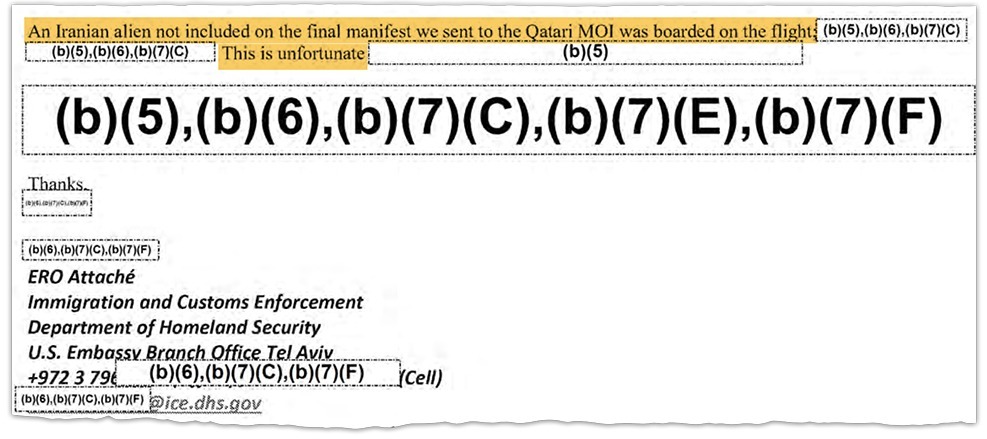
After the stopover in Doha, the accidental passenger was sent to Iran anyway.
A spokesperson for the Department of Homeland Security, the parent agency of ICE, declined to comment on the apparent mix-up.
Formal diplomatic relations between the U.S. and Iran have been severed since 1979, and communications between the two nations have typically taken place either through intermediaries or through Iranian representatives operating out of the Pakistani Embassy in Washington, D.C. That made the issuance of travel documents necessary for deportation nearly impossible, and Iranians were often allowed to remain in the country indefinitely.
Yet the move to begin deporting Iranians took place at a time in which relations between the U.S. and Iran were at a particularly low point.
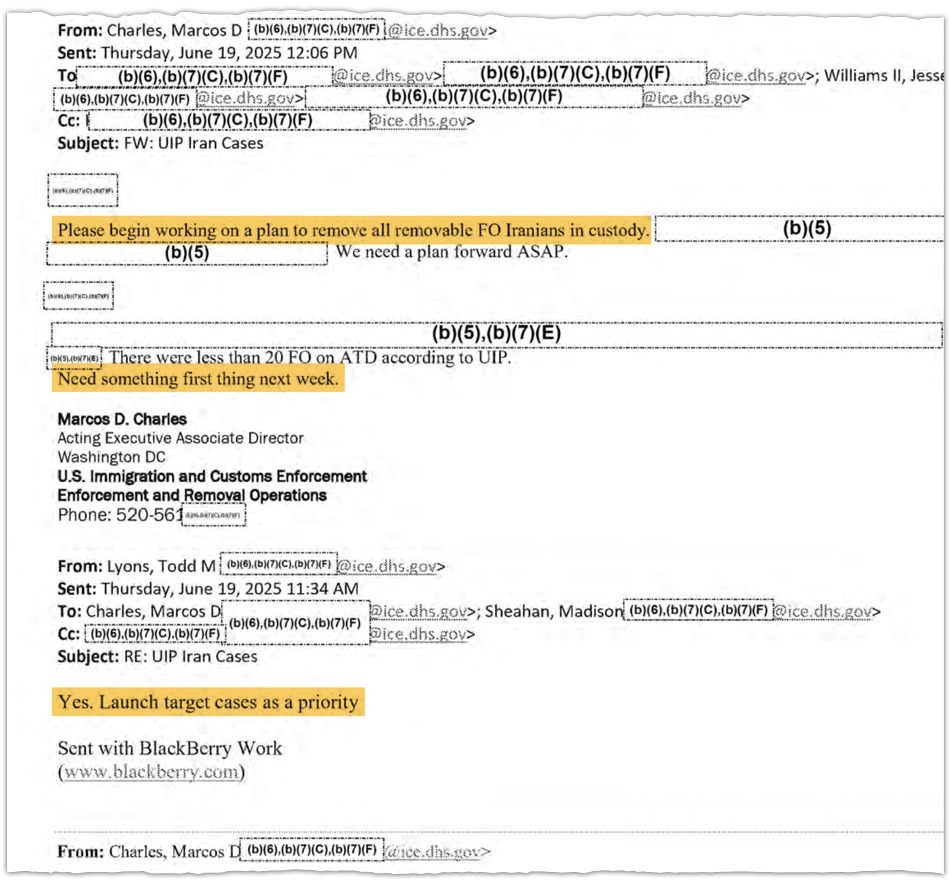
The so-called Twelve-Day War was in full swing when, on June 19, 2025, the orders came down to ICE officers to begin putting plans into motion.
In an email sent from his BlackBerry to Charles and Sheahan that day, Lyons directed his underlings to “launch target cases as a priority.” Less than an hour later, Charles forwarded Lyons’s missive to several ICE officials and included marching orders of his own.
“Please begin working on a plan to remove all removable FO [final order] Iranians in custody,” Charles wrote. “We need a plan forward ASAP.”
In a series of emails among ICE officials, all of whose names were redacted, the pressure to develop a plan was clear. One staffer, whose email signature listed them as an assistant director of the ERO’s removal division, appeared pessimistic about the timing.
“Unfortunately I do not have great news,” wrote the staffer. “I’ve learned from the team that Iran is currently uncooperative and does not issue [travel documents] in a timely manner.”
As a result, the staffer told Charles, “removal will prove difficult.” To make matters worse, “due to the current conflict, the airspace in Iran is closed to all ( not just U.S.) until further notice,” wrote the official. “Neighboring land borders are also a challenge.”

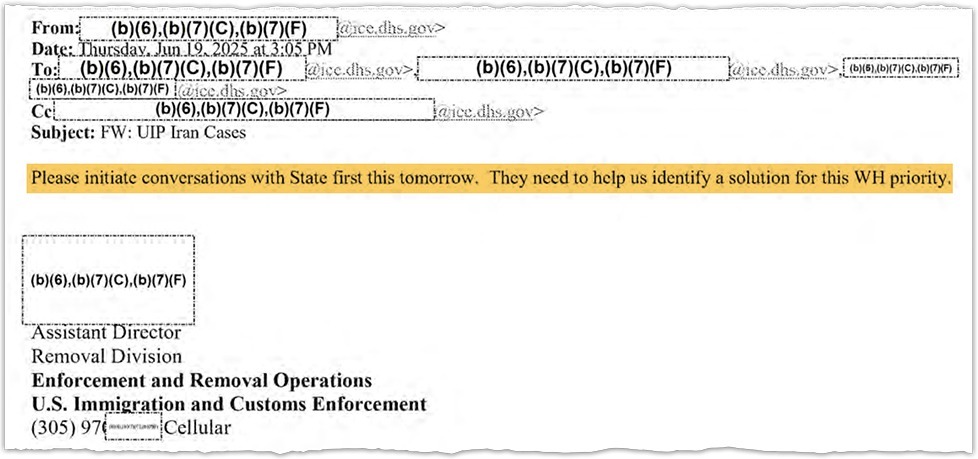
Still, in other emails, the assistant director urged colleagues to press ahead with the orders.
“Please initiate conversations with [the Department of] State first this [sic] tomorrow,” the official wrote in an email forwarding the commands to his colleagues. “They need to help us identify a solution for this WH [White House] priority.”
Just 24 hours later, however, an ICE official wrote with good news.
“The team has come together and developed a few viable options for removals to Iran,” the official wrote. All of the plans were redacted.
Lyons, Charles, and Sheahan did not respond to requests for comment. When The Intercept contacted Coster at his official ICE email address, the reporter received an automatic out-of-office reply indicating that Coster’s area of focus had shifted to North Africa.
For years, Iranians facing deportation from the U.S. have been protected by two realities: the lack of diplomatic relations between the two nations and the threat of retribution at home.
But the Trump administration has dispensed with both roadblocks in its quest for mass deportations, in which Trump has dismantled the asylum system for refugees from almost any country — with the notable exception of white Afrikaners.
“It seems that this administration will stop at nothing to make sure that these physical deportations actually happen, no matter what the cost, and they’ll just turn people over to despotic regimes,” said Hassan Ahmad, an immigration attorney who has represented a number of high-profile people targeted for deportation in recent years. “I’ve been an immigration lawyer a long time, but with this administration, every day it’s a new low.”
It has become virtually impossible for ethnic minorities and political dissidents fleeing persecution in Iran to find safety in the United States, despite Trump’s strident criticism of the Iranian government’s human-rights record.
“Iran commits grievous human rights abuses and arbitrarily detains foreigners, including United States citizens, on spurious charges without due process of law, subjecting them to abuse,” Trump wrote in a February 2025 national security policy memo announcing his administration’s “maximum pressure” campaign. The following January, during a deadly crackdown on protests against the Iranian government, Trump issued messages of support for the people of Iran opposed to the regime — even as ICE agents were set to deport a dozen more people to Tehran later that month.
Amid all its bluster against Iran, his administration was doing everything it could to send Iranians back to that government. In June 2025, according to figures tallied up in an email from Charles, there were 522 Iranian nationals in ICE detention, including 244 who were under a final order of removal, and another 278 who were in removal proceedings. Charles wrote that the agency’s internal portal showed more than 5,000 other cases of Iranians in deportation proceedings who were not in ICE custody.
Around that time, ICE embarked on a dramatic scaling up of detentions of Iranian nationals not already in custody, arresting between 290 and 300 people between June and July of that year, according to NIAC’s data.
“At the same time the U.S. and Israel were plotting a new phase of war with Iran, ICE’s attaché in Israel was coordinating to send asylees back to a government that threatens their lives,” Abdi said. “The people of Iran are wronged at every turn: by their authoritarian government and by the U.S. that speaks as if it is their ally, only to pursue policies that block them from the American dream, impoverish them, and drop thousands of bombs on their country.”
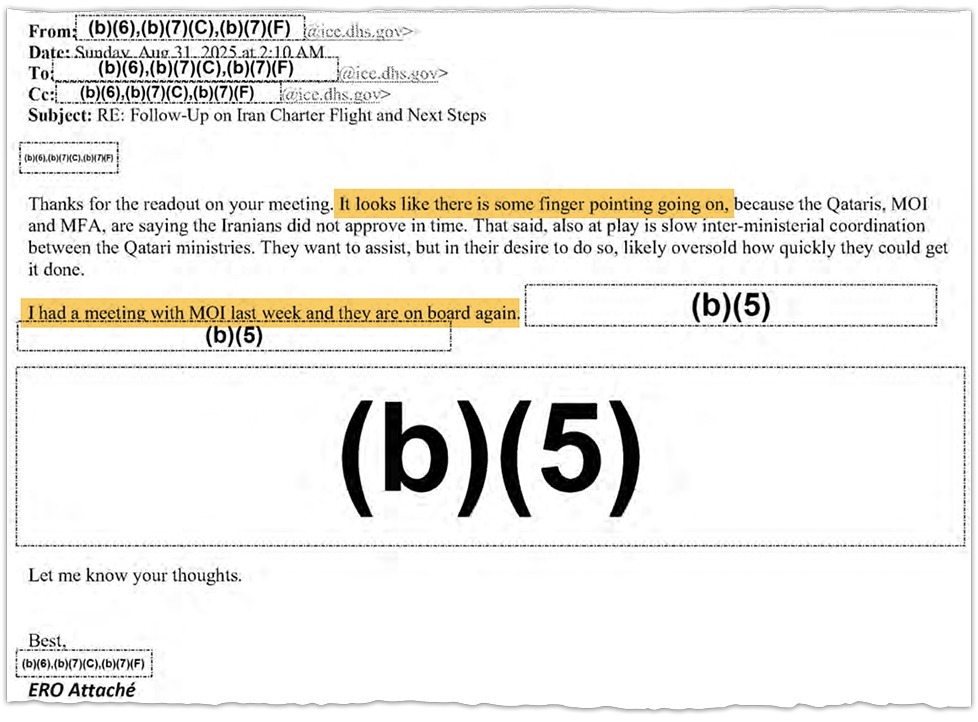
The first war with Iran under the second Trump administration ended on June 24, 2025, and efforts to organize the first flight to Tehran continued apace. Throughout August, ICE agents at field offices around the country made repeated mention of a charter flight scheduled for later that month. But by August 22, that charter appears to have fallen apart.
“It looks like there is some finger pointing going on,” wrote Coster, the ERO attaché then based in Tel Aviv, “because the Qataris, [Ministry of the Interior] and [Ministry of Foreign Affairs], are saying the Iranians did not approve in time.”
A few days later, his colleague was passing on an ask from Iranian officials. “Iran has requested that I amend the previous manifest an expedite the removal process,” an ERO officer wrote on August 29, with further specifics redacted. Within a month, the plan was a go.
On September 29, a plane operated by the private contractor Omni Air and brokered by CSI Aviation, neither of which responded to The Intercept’s requests for comment, took off from the Alexandria Staging Facility in Louisiana and flew to Puerto Rico for a brief refuel before traveling on to Cairo, according email records and to data provided to The Intercept by ICE Flight Monitor at Human Rights First.
After a stop in Cairo, the plane continued on to Qatar, with 54 Iranians onboard, who were transferred to a charter flight operated by the state-owned Qatar Airways. On October 1, at about 11:00 a.m. local time, the Qatar Airways flight arrived at its final destination, at Imam Khomeini International Airport in Tehran.
For reasons that are not made clear in the emails, the Iranian deportees numbered fewer than half the 120 Iranian nationals that Qatar and Iran were expecting. The Qataris were not happy.
“We would like clarification on why the number of passengers has been reduced from 120 to 54, as this directly affects our internal operations,” wrote a representative of the Qatari Ministry of the Interior in an email to ICE officials. “Last-minute changes are not welcome, especially since we are an intermediary with the Iranians.”
If U.S. officials gave an explanation to Qatar, it does not appear in the correspondence. The emails do reveal the inclusion of an Iranian not slated for the flight — as well as further specific requests from Iran, in which officials appear to ask that certain individuals be sent back to the country.
“The lran Embassy just issued passports or travel documents for the three listed below. They requested they be added to the flight leaving out on the 29th,” an official wrote on September 26, 2025.
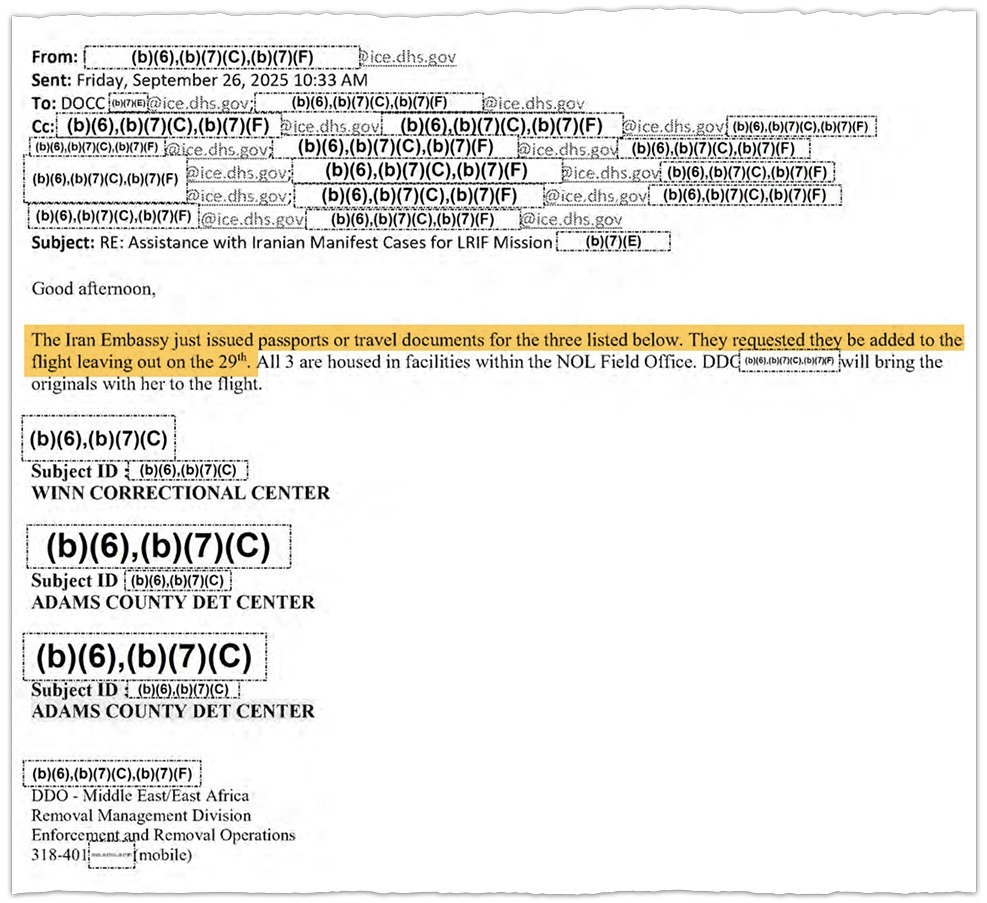
The description of coordination between representatives of the two hostile nations, and the requests from Iran that individuals be included in the flight appears to bolster claims made in a lawsuit filed last month in federal court by the Iranian American Legal Defense Fund, which accused ICE of handing over sensitive information to the Iranian government. In court filings, ICE has dismissed those claims as “hearsay.”
In response to a detailed list of questions, a spokesperson for DHS again denied sharing sensitive information with the Iranian government.
“These allegations that ICE shared asylum application records with the Iranian government are FALSE,” the spokesperson wrote. “ICE is committed to ensuring that illegal aliens are informed of their right to communicate with their consular representatives. Consistent with established protocols, ICE provides illegal aliens the opportunity to contact their consular post and facilitates consular access to detained individuals, in accordance with applicable laws, regulations, and agency policy.”
The emails end on November 25, when the U.S. was planning a second flight that transited deportees to Iran through Kuwait on December 7. A third flight took place on January 25, again through Kuwait, and a fourth one was scheduled for late March.
According to filings in the lawsuit, it was derailed when, in late February, the U.S. and Israel again began bombing Iran.