

All France News


Alain Stephens is an investigative reporter covering gun violence, arms trafficking, and federal law enforcement.
At the Milan Cortina 2026 Winter Olympics, competing under the American banner has put some athletes at odds with their own government, transforming them — in a handful of candid remarks — from cereal-box patriots into political liabilities swiftly pilloried by the conservative establishment.
When reporters asked American freestyle skier Hunter Hess how it felt to wear the U.S. flag in front of the world in this moment, he said it “brings up mixed emotions.” Hess drew a clear line between the country he competes for and the policies coming out of Washington, saying, “Just because I’m wearing the flag doesn’t mean I represent everything that’s going on in the U.S.”
Hess’s plain, honest answer triggered one of the most striking political crosscurrents of these Games: President Donald Trump logged on to Truth Social to call Hess “a real loser” who shouldn’t have tried out for the Olympic team at all.
Hess wasn’t alone in speaking out. Curler Rich Ruohonen, an attorney and Minnesota native, criticized recent federal law enforcement actions in the state, saying the operations were “wrong” and violated Americans’ constitutional rights. Snowboarder Chloe Kim, whose parents immigrated to the United States from South Korea, defended her fellow teammates, saying Trump’s immigration policies “hit pretty close to home” and that athletes are “allowed to voice” their opinions.
The response from conservative media was instant: shame, dismissal, and, at times, openly cheering against the very athletes carrying the American flag.
Vice President JD Vance told reporters that Olympians are “not there to pop off about politics” and said they should expect “pushback” if they do. Florida Rep. Byron Donalds went further on social media, telling U.S. athletes that if they don’t want to represent the flag, “GO HOME.”
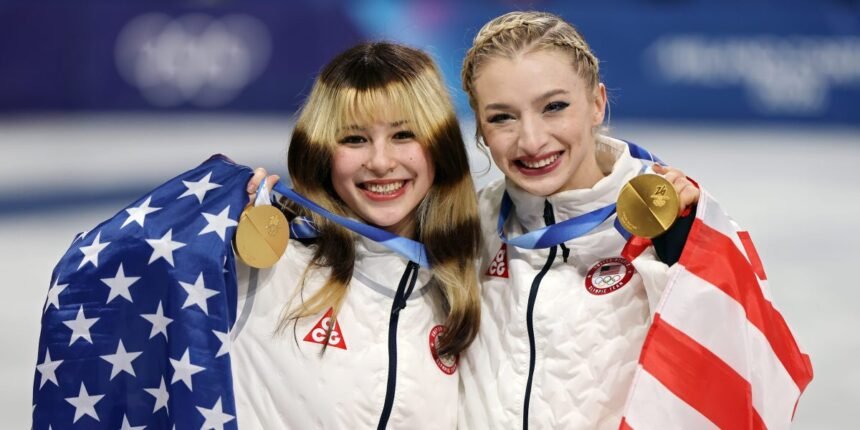
Conservative commentators also charged in on behalf of the administration. After U.S. figure skater Amber Glenn, who won gold in the team event, voiced support for her LGBTQ community, conservative podcaster and former Fox News host Megyn Kelly branded her “another turncoat to root against” to her 3.6 million followers. The outrage snowballed, and Glenn said she received a “scary amount of hate/threats,” prompting her to take a break from social media altogether. (She later returned to TikTok with a carousel of images of her and teammate Alysa Liu wearing their team gold medals and addressing her critics: “They hate to see two woke bitches winning.”)
The intensity of the backlash illustrates how symbolic these Games have become — not just for who wins medals, but for who gets to define what national representation means on the international stage. While the Olympic Committee and the U.S. government prefer to present the Games as a neutral display of discipline, athletic poise, and national pride, the truth is less tidy. The Olympics have always served as a global window into the political and social conditions athletes come from — and when that window opens, protest has rarely been far behind.
Seen, Not Heard
Although the modern Olympic Charter’s Rule 50 aims to ban political, religious, or racial “propaganda” from competition, the idea that the Games have ever been apolitical ignores more than a century of history. Long before the International Olympic Committee tried to censor athletic competition, athletes and states recognized there was no separating sports from politics. At the 1906 Athens Games, Irish track and field star Peter O’Connor protested being listed as a British competitor by climbing a 20-foot flagpole and unfurling a green flag bearing the words “Erin Go Bragh” — Ireland forever — and went on to win gold.
As the Olympics entered the broadcast era and the audience stretched far beyond the stadium, political leaders were acutely aware they could use the Games’ reach to bolster their legitimacy. By the 1936 Berlin Olympics, Adolf Hitler and his propagandists transformed the Games into a showcase for the Nazi regime’s image and ideology. The widely publicized spectacle of a nation unified under Nazism was engineered to sanitize the Third Reich at home and abroad, cementing the modern Olympics as a global platform for state propaganda — and, inevitably, for those willing to resist it. Jewish organizations, labor leaders, and civil rights groups in the United States and Europe tried to organize a boycott of the event, warning that participation would validate Hitler’s regime and its persecution of Jews, but the effort ultimately failed. Athletes responded with the most direct act of resistance available to them: by winning, in open defiance. Jesse Owens — an African American runner — shattered Hitler’s carefully staged narrative of “Aryan” superiority by winning four gold medals, turning his victories into a de facto rebuke of the regime’s racial ideology.
Decades later, the 1968 Mexico City Games delivered one of the clearest political statements in Olympic history: sprinters Tommie Smith and John Carlos raising black-gloved fists on the medal stand in protest of racial injustice in the United States — an enduring image that turned the podium into a site of public dissent in front of the world.

The backlash was swift. Olympic officials expelled them from the Games, much of the press cast them as radicals, and both men faced threats and professional fallout for years afterward. Their protest remains one of the most controversial moments in Olympic history — and, as Smith later put it, entirely necessary: “We had to be seen because we couldn’t be heard.”
At the 2024 Paris opening ceremony, Palestinian boxer Waseem Abu Sal wore a shirt depicting the bombing of children in Gaza and told AFP it was meant to represent “the children who are martyred and die under the rubble,” bringing the war’s human toll visibly into the Olympic spotlight.
Across decades and continents, athletes and nations alike have used both participating in and abstaining from the Olympics to make statements about war, occupation, racial oppression, and human rights. This long history underscores a simple truth: When the whole world is watching, both governments and their critics understand the Games are too powerful a platform to leave unused.
More Than a Podium
American Olympic success is not a vacuum. An analysis by researchers at George Mason University found that roughly 3 percent of athletes on Team USA at the 2026 Winter Games were born abroad and another 13.5 percent are children of immigrant parents — meaning nearly 17 percent of the delegation has direct ties to immigrant communities. That reality reflects how the United States develops and recruits athletic talent across communities, including immigrant families and underrepresented groups whose contributions have long powered American sports on the world stage.
For athletes whose families or personal histories intersect with immigration pathways, this shift is not an abstraction. It’s about who has secure status in the United States and who faces potential removal or legal uncertainty. The ways in which these forces shape an athlete don’t stop when they step on the snow or ice, no matter what flag is on their back.
The Games are built on spectacle, but beneath the pageantry is a hard truth: Athletes do not compete only for themselves, they compete as symbols of the nation they represent. When Americans step onto that global stage, they are presented as proof of what the United States claims to stand for — freedom, dignity, equality — even as the country itself struggles to live up to those ideals. That contradiction carries a real moral weight. Competing under the flag is not just an honor; it’s a responsibility to confront the distance between national image and national reality.