

All France News
Last spring, President Donald Trump issued the “Restoring Truth and Sanity to American History” executive order, taking aim at federal parks, monuments, museums, and sites that have cast the United States’s “founding principles and historical milestones in a negative light.” On the Fourth of July this year, the White House published its 162-page “Saving America’s Story,” attacking the Smithsonian Institution directly for “anti-white activism,” “illegal alien activism,” “transgender activism,” and more broadly for adopting “an ideological framework that no longer treats the American story as a shared national inheritance to be taught or celebrated, but as a political instrument to divide, dispirit, and discourage our citizens.”
“We’re in this moment where we are fighting over how America tells its past,” journalist Rebecca Nagle tells The Intercept Briefing. “It can be scary in a moment when it feels like the stakes are really high to really interrogate the myths that we all carry, that we all hold about who our country is and where it started because it’s really tempting to want to think, ‘OK, if we just wind the clock back 10 years, if we just go back a few election cycles, we’ll be back to a democracy that’s strong, that’s stable, that’s solid, and we’ll all be fine.’ It’s much more scary to say, ‘Oh, actually, if we want to talk about where authoritarianism comes from in the United States, it’s actually at the foundation.’”
As the United States celebrates its 250th birthday this year, the Trump administration has been ramping up its efforts to erase not just the dark parts of U.S. history but also the contributions of basically anyone who isn’t a white, Christian man. That project has included taking concrete steps to remove all traces of the history of people who don’t fit that description, Black people, immigrants, civil rights advocates, women and gay and trans people — including the first people to live on this land: Native Americans.
This week on the podcast, Nagle speaks to host Akela Lacy about her new podcast series “First America,” which examines how Native people have been largely written out of the American story, and how that story informs the current political crisis in the U.S.
“One of the big claims that the series makes is that the foundation is in itself is a myth. Because at the same time that our founders were building a democracy, they were also building an empire. The way that you govern an empire, the way that you govern other people by force, is not democratic,” says Nagle, a citizen of Cherokee Nation. “This identity crisis we’re having around authoritarianism and democracy, and how could authoritarianism be sneaking into our democracy — what we argue is that it’s actually always been there.”
“A lot of what is happening now — it’s not new, it’s not un-American, it’s not unprecedented. Sometimes it’s not even unconstitutional! It’s actually just taking these parts of our government that for a long time most Americans didn’t know was there or didn’t really think about, and Trump is just pulling it into the center,” says Nagle.
For more, listen to the full conversation of The Intercept Briefing on Apple Podcasts, Spotify, YouTube, or wherever you listen.
Transcript
Akela Lacy: Welcome to The Intercept Briefing. I’m Akela Lacy, senior politics reporter at The Intercept.
The United States is celebrating its 250th birthday this year.
President Donald Trump kicked off festivities by hosting a UFC cage match on the White House lawn to also celebrate his 80th birthday.
CBS: President Trump and UFC President and CEO Dana White kicked off the historic event that started with the national anthem and a joint Air Force and Navy flyover.
VO: From the south lawn of the White House.
[Clip ends]
AL: Then there was Trump’s two-week-long Great American State Fair in D.C., which aside from the Fourth of July, ended up being a giant bust.
[Clips montage]
MS Now: Donald Trump’s long-awaited Freedom 250 Great American State Fair went off with a whimper this weekend with what looked like tens, dozens of people showing up for the event.
FT: Donald Trump has said that this event is packed with happy people loving it, but it is 6 p.m. in the middle of the week, and there is hardly anyone here.
MS Now: This was the scene on Tuesday when there were actually more people in the band on stage than there were in the crowd watching them.
AL: Meanwhile, the Trump administration has been ramping up its efforts to erase not just the dark parts of U.S. history, but also the contributions of basically anyone who isn’t a white, Christian man. That project has included taking concrete steps to remove all traces of the history of people who don’t fit that description: Black people, immigrants, civil rights advocates, women and gay and trans people — including the first people to live on this land: Native Americans.
After reviewing nearly 2,000 flagged materials from National Parks and Monuments, The Guardian found that one Trump executive order resulted in the targeted removal of signs about “Native American history, slavery, the climate crisis, and the civil rights movement.”
Native American history is already poorly understood or misunderstood in the U.S. A new podcast series called “First America” examines how Native people have been largely written out of the American story. Host and creator Rebecca Nagle, a citizen of Cherokee Nation, argues our current political moment is 250 years in the making.
[Clip plays]
Actor: We hold these truths to be self-evident, that all men are created equal.
Nick Estes: The Declaration, which is full of these beautifully rendered sentences and paragraphs about Enlightenment ideals, does also have this darker history to it.
Actor: The merciless Indian savages whose known rule of warfare is undistinguished destruction of all ages …
Nick Estes: If we don’t understand the full context in which our nation was founded, we won’t understand the full context in which our nation now finds itself.
Rebecca Nagle: So, it’s been 250 years since 1776. How’s this democracy of ours going?
[Ambient sounds. Clip ends]
AL: Rebecca Nagle is an award-winning advocate and writer focused on advancing Native rights and ending violence against Native women. You might remember Nagle from her hit podcast “This Land,” which focused on treaty rights and tribal sovereignty in Oklahoma. She joins me now.
Rebecca Nagle, welcome to The Intercept Briefing.
Rebecca Nagle: Thank you so much for having me.
AL: Before we jump in, I want to let our listeners know that we’re also going to drop the first episode of “First America” into our feed so you can listen.
Rebecca, you have a new podcast series out, called “First America.” In the first episode, you open with this scene where you and history professor Nick Estes visit Fort Snelling in Minnesota. It’s January 2026. Set the scene for us? Why did you start the series there?
RN: Nick is a citizen of the Lower Brule Sioux Tribe and a historian. We were visiting Fort Snelling, which was a concentration camp in the 1860s during the Dakota Wars.
Dakota families were held there as actually part of a broader effort to force all Dakota people to leave the state of Minnesota, and that effort included death marches, it included open-air prisons, it included mass executions. It was extremely violent. We were there, actually, really to just see how the site talked about it.
The site doesn’t really know, it seemed like, how to integrate the history. There’s this giant replica for it that school kids visit that’s mostly celebrating the military history of the site. Then in this sort of tucked away corner, if you walk down a long, snowy path, there’s a memorial to the victims of this chapter of genocide.
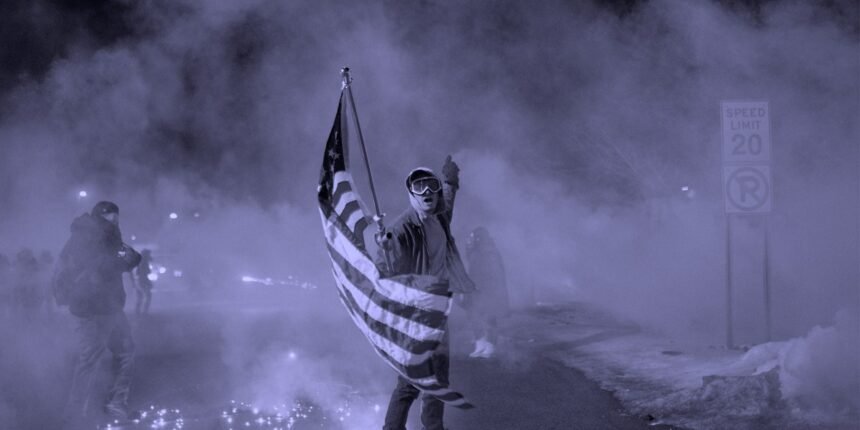
The history of the fort is not really integrated in the way that Minnesotans tell the history at that site. While we’re there that day, Nick got a call from his wife that ICE had just shot and killed someone; it was the day that ICE killed Renee Good. The next day, I was actually back at Fort Snelling — this time not to visit the historic fort, but actually for a protest.
So where ICE is headquartered in Minneapolis is on the Fort Snelling campus. There’s the historic fort, but then there’s this broader Fort Snelling campus. ICE is there because it’s federal land, and it’s federal land because it was once a military reservation. So what you see is the federal government doing the same thing — rounding people up and detaining them — in the same place.
When I first started this project, I thought I was just making a history podcast. I thought I was talking about the founding and how Native people have been left out of that story and correcting the record. The project actually started as conversations between me and Nick about how Native people are left out of American history and the American story.
And then this thing kept happening where I would be somewhere learning about America’s past, and the same thing would happen in our present. What I realized is that this history — that as a country we don’t know how to talk about, that we haven’t reckoned with — the history that we keep in a memorial that’s tucked away in a corner, that history is why the present moment is happening.
“What you see is the federal government doing the same thing — rounding people up and detaining them — in the same place.”
AL: I also want to mention for our listeners, Nick Estes has written some really great reporting for The Intercept, which I encourage people to check out.
We’re talking about your series a few days after the Fourth of July weekend, and the United States is still celebrating its 250-year birthday which dates back to, obviously, the Fourth of July signing of the Declaration of Independence in 1776, a document which you dive into in the podcast.
But I will quote for our listeners who might not have it on hand. The Declaration reads, “We hold these truths to be self-evident, that all men are created equal,” while also describing Native Americans as “merciless Indian savages whose known rule of warfare is undistinguished destruction of all ages, sexes, and conditions.”
It’s well known that this and many other contradictions exist in our founding document, but why was this important for you to underscore here? What does it tell us both about our history, but also about today?
Rebecca Nagle: One thing that is important is the meaning of the word “savages,” and what does it mean for our founders to call Native people savages?
We all know the part of the Declaration of Independence that we’re taught in school — that all men are created equal; life, liberty, pursuit of happiness. But alongside those Enlightenment ideals, the founders included really their deep hatred for Indigenous people. The word “savages” has a really specific meaning in the late 1700s, which is that there are societies and groups of people that are seen as civilized, as deserving of human rights, and then there are people that are something less than human, and those are savages.
It’s a term that at the time carries a lot of meaning, and the founders are saying, “We’re not going to extend these Enlightenment ideals to these Indigenous people, to these savages.” The other reason that it’s really important is because it was important to our founders, right?
This isn’t just a throwaway line in the Declaration of Independence. Many historians think that the Declaration of Independence has an order. A lot of people, we know the preamble, but we don’t actually know what the majority of the document is. So the majority of the document is just this long list of grievances, and it’s basically the founders’ reasons for why they’re rebelling against the Crown.
A simple way I like to explain it is that it’s almost like a breakup letter — at least like a bad breakup, where you tell the person everything that they did wrong. The founders are doing that to King George, where they’re just like, “And you were a jerk, and you left your laundry everywhere.” It’s kind of like that list.
A lot of historians think that that list has an order and that it starts with smaller things and then ends with the things that the founders were most upset about.
The last grievance — the 27th grievance — is this line about “merciless Indian savages,” and there’s a whole history to why that line is in the document.
“What we see in that last grievance and the history behind it is that actually one of the main motivating factors for the Revolution itself was hunger for more Indigenous land.”
That history tells us a different story than the one we’ve all grown up knowing: It was about taxation and representation, and this is why the Revolution happened. This is what the founders were fighting for. What we see in that last grievance and the history behind it is that actually one of the main motivating factors for the Revolution itself was hunger for more Indigenous land.
The colonists wanted to expand west. The king of England was telling them no. They were really angry about that. They did a lot of different things, but they also put that anger in the Declaration of Independence. To me, it just goes to how deeply Native people are erased from the American story. It’s not like you have to rifle through Thomas Jefferson’s personal papers to be like, “Oh, look here. He said here in this journal that he was mad about Indigenous people.” They put it right there in our country’s most famous document. But somehow as Americans, we don’t know this story.
AL: We’re talking about this in the U.S. particularly when it comes to the “founders.” As you mentioned, most people don’t know that the first president, George Washington, was a land speculator interested in seizing Indian land. Can you tell us a little bit more about that history?
RN: For people who don’t know, and it’s not just George Washington, a lot of the gentry men of this era —
AL: The good men.
RN: — are involved in this business called land speculation. Actually George Washington’s family did it. It was a pretty well-established practice. But basically what they would do is they would buy land that either England and then later the United States claimed in this racist, abstract way where they would sail somewhere and plant a flag and be like, “This is our land.” But it’s still governed and controlled on the ground by Indigenous people.
They would buy that land, and then like a modern-day real estate developer would flip it, they would flip it. Once Indigenous people were forced off that land, they would sell the land to settlers for a profit. Sometimes they would sell the land while Indigenous people were still living there.
What happened is in the 1760s, there was this Indigenous uprising where a group led by an Odawa chief named Pontiac sacked a bunch of British forts.
So Britain, in a very loose way, claims all this land in the Great Lakes region. The way they claim that land on the ground is by having these forts; they’re these military outposts. And Indigenous nations sack a bunch of them.
The Crown is looking at fighting a very expensive war in North America. It’s just been fighting this big global war, sometimes called the French and Indian War, sometimes called the Seven Years’ War, and it’s broke — the Crown is broke. It doesn’t want to fight another war with Indigenous nations. What the Crown does is it makes this line, this proclamation, issues a royal proclamation, and that royal proclamation draws a line basically down the Appalachian Mountains, and it tells settlers, colonists: “You can live to the east of this line, but everything to the west is reserved for Indigenous nations.”
And what we have is George Washington telling his kinda business guy, “Hey, ignore the proclamation and continue to buy land and speculate in land west of the King’s boundary. We’re not going to follow this law.” We know that the elite didn’t like the Royal Proclamation of 1763, and it also upset regular folks too who felt entitled to more Indigenous land out west.
AL: You’re talking about this project as a way to correct the record, as you said, when it comes to U.S. history and Native peoples. It brings to mind another effort by journalist Nikole Hannah-Jones who published “The 1619 Project,” recasting the way we understand how slavery shaped the founding of the country.
There was a massive backlash to that project. I’m curious, have you gotten any pushback on this series in that vein?
RN: Not to the extent that “The 1619 Project” did, by a long shot.
AL: It would be hard to replicate that.
RN: Yeah, I also just think we don’t have the visibility of The New York Times. It’s a different cultural moment. There have been a few right-wing websites that have criticized the podcast and perhaps there’ll be more. We’ll see what happens.
What I will say, broadly speaking, is that we’re in this moment where we are fighting over how America tells its past. That fight is really important, which is also why projects like “The 1619 Project” are really important and are definitely an inspiration for the work we’re doing with First America.
But I think that the fight over who we are as a country, where we come from, how we started — that fight is so bitter because so much power flows from the stories that we tell ourselves. The stories that we tell ourselves as a country about who we are and where we come from, I believe, really shape public policy and public sentiment, and how we have these conversations around law, around equity, today.
What I will say as a Native person is what I often feel like I experience is both sides leaving us out. So we’re left out of the “America was great, 250, rah, rah, rah, the founders were perfect” version of the story, because obviously genocide doesn’t fit easily into that version. But we’re also left out of the more progressive side, too — things like the No Kings protest, or this idea of wanting to go back to this democratic foundation.
“At the same time that our founders were building a democracy, they were also building an empire.”
One of the big claims that the series makes is that the foundation is in itself is a myth. Because at the same time that our founders were building a democracy, they were also building an empire. The way that you govern an empire, the way that you govern other people by force, is not democratic. So this identity crisis we’re having around authoritarianism and democracy, and how could authoritarianism be sneaking into our democracy — what we argue is that it’s actually always been there. I don’t think people, on both sides of the aisle, I feel like most people aren’t having that conversation.
[Break]
AL: There are a lot of people — similar to the critics of “The 1619 Project” — there are a lot of people out there who might brush off efforts to look into the past, as you’ve mentioned, or say they’re not reflective of how much progress has been made since then on things like racial equality or civil rights.
As you’ve said, this is a history that is uncomfortable for people that they don’t want to talk about. But what’s your response to someone, including potentially people among our listeners, who might have that perspective?
RN: I’ll just give one example. So there’s been a lot of talk around presidential war powers and what power the president has to go to war, to bomb another country without congressional oversight.
There’s been a lot of moments of controversy in Trump’s second term: bombing boats in the Caribbean, abducting the leader of Venezuela, the war with Iran. A lot of people have said, “Oh, the president really shouldn’t be able to do this without congressional approval, without a formal declaration of war.”
The first undeclared war that the U.S. fought was fought under the George Washington administration in the late 1700s. It was a war with Indigenous nations. That war is not only precedent for why presidents can fight wars without congressional oversight, but is also why we have such a big military, is why we even have a central military. At first, we didn’t actually really have a big standing army, and the founders didn’t want one. It also is a big part of why the wars that the U.S. fight is plagued by human rights abuses.
So for people who want to say, in kind of a vague way of, “Oh, we shouldn’t be talking about history. We should be focused on the present” — I don’t think we can understand where we are as a country and how we got here without understanding where we came from. I actually think that so much of our current political crisis is from us not really knowing how our country started, and really what the full structure and character of our government is.
AL: On a similar note, you explore in the series how Native Americans have been erased and left out of the 250-year history of the United States. This has long been the case, as you lay out time and time again, absence in museums, cultural sites, National Parks, et cetera.
Now we’re living under a president who wants to further erase that history. Why does Donald Trump want to try to further erase Native history, and what does he get out of it? What does anyone get out of that?
RN: I am not an expert in authoritarianism and fascism. We talk about it in relationship to colonialism in the podcast, but what I will say is that an important part of those types of leadership is having a very specific kind of national narrative.
What you see happening right now, whether it’s banning books, changing curriculum, taking down signs at National Parks, is really this effort to have a very specific type of image of the United States and a very specific kind of national narrative that aligns with people’s political goals.
It can be scary in a moment when it feels like the stakes are really high to really interrogate the myths that we all carry, that we all hold about who our country is and where it started because it’s really tempting to want to think, “OK, if we just wind the clock back 10 years, if we just go back a few election cycles, we’ll be back to a democracy that’s strong, that’s stable, that’s solid, and we’ll all be fine.
It’s much more scary to say, “Oh, actually, if we want to talk about where authoritarianism comes from in the United States, it’s actually at the foundation.” That’s really scary to think about, but it’s really important because if we don’t understand how deep it goes, we actually won’t be able to root it out.
It’ll be like chopping the head off of a weed; it’ll just grow back stronger. And I actually think we already saw that between Trump 1.0 and Trump 2.0. We did the thing where we all voted, Trump was out of office. It was really scary — didn’t look like maybe there would be a peaceful transition of power.
Then the second administration has actually been stronger than the first, and accomplished, I would say, more of their goals. It’s really important for us to get really specific if we want to defeat authoritarianism in America, for us to get really specific about where it comes from, and that process is going to be, for all of us, interrogating some of the myths that we hold about the United States and about U.S. democracy.
AL: Something that’s interesting about this is the question comes up, OK, what is so horrifying about conceding that the founders were calling Indian savages, viewing people as less than human, owning slaves, fighting to keep themselves in the same socioeconomic class at whatever cost? And part of it is potentially that if living in the U.S. today is a product of a document that was rooted in authoritarianism, then do we know what authoritarianism looks like?
Obviously, we didn’t stop it, right? Because we’re now in Trump 2.0, and I think that it’s like we can confront all of these other horrific things in the world day in and day out, like how is this still a conversation that we’re having?
RN: The story we’ve been told about American democracy, it has been ingrained in us so deeply. Then at the same time, the other thing that’s been ingrained in us so deeply is the erasure of the people that our government colonized. We erase what our government did to Native people. Where we do talk about it, it’s in passing mention.
“The other thing that’s been ingrained in us so deeply is the erasure of the people that our government colonized.”
We also erase what our government did to places like Guam and Puerto Rico and the Philippines. So we have this long history of our government ruling through force, like taking over other people’s land by usually through extreme violence and military control.
It’s not just that we did that and it went away — we built a government to do that. We built departments and secretaries and methods and technologies and got better at it as we did it more, really to pull it apart is to see that at the same time that our founders were building a Constitution for themselves, they called it an empire of liberty, but they were also building an empire and an arm of the American government that did not operate with elections, that did not operate through consent, that did not have due process or freedom of speech or freedom of religion.
At different times in U.S. history, the U.S. federal government has controlled where Native people can live, where Native people can even move their bodies, how we raise our children, if we can have children, what languages we can speak, what religion we can practice, what food we can eat — all against our will. That’s not democracy. Again, you can call it colonialism, you can call it empire, but it’s government by force, which is also another way to say authoritarianism.
What we have to pull apart in this moment is understanding how deep that goes. This is really from the scholarship of a legal scholar that we talk to pretty extensively in the podcast named Maggie Blackhawk, who is at NYU and is Ojibwe.
But what we’re seeing in the present moment is these practices of our government around how much power the president has, how much power the courts have to intervene, that have built up over time. Now we have someone like Trump in office, and oops, we gave the president a ton of power over war when we were fighting Indigenous nations. We gave the president a ton of power over things like the military and foreign affairs.
A lot of what is happening now — it’s not new, it’s not un-American, it’s not unprecedented. Sometimes it’s not even unconstitutional! It’s actually just taking these parts of our government that for a long time most Americans didn’t know was there or didn’t really think about, and Trump is just pulling it into the center.
“They were also building an empire and an arm of the American government that did not operate with elections, that did not operate through consent.”
AL: You’ve given a couple of examples of this, but I wonder if you can zoom out a little bit and connect the dots a bit more on how, as you’ve put it, the specific Native part of our history helps to explain the current political crisis.
RN: Again, this is from the scholarship of Maggie Blackhawk, who’s Ojibwe and her work is amazing.
I’ll tell a story. The same summer our founders were drafting the Constitution in Philadelphia; at the time New York is where Congress met, the Congress at the time. A bunch of people actually leave the Constitutional Convention in Philadelphia so Congress can have a quorum in New York.
So you’ve got these two meetings happening at the same time. In New York, Congress passes the Northwest Ordinance to govern an area that’s like Ohio to Minnesota. It’s like the Great Lakes region. The founders actually call this area America’s first colony, and they’re going to govern it like a colony.
The person who oversees the colony is appointed, is not elected. There aren’t elections, even for the white people — it’s majority Native — but even for the white people who are living there, they don’t have elections. They don’t have a representative in Congress. It’s not democracy the way that we would think about it.
It’s top-down government. That’s how we’ve ruled every territory as we stretch from sea to shining sea, and then as we stretch from the Philippines and Guam and Puerto Rico, and as we governed big, huge swaths of area that way. This isn’t a small subset of the United States. Under Thomas Jefferson’s presidency, two-thirds of the land mass of the United States was governed by unelected appointed leaders.
The way that we governed those areas built up certain practices. It’s a big legal term, it’s called plenary power. But it basically built up a stronger president. These are areas where the president could get away with a lot and kinda do what the president wanted. It’s an area where also the courts have this tradition of saying, “Ah, like this isn’t really our business. We’re not going to intervene. We’re going to defer.” There are also areas where constitutional rights don’t apply as much. Native people were the first example of that. We’re the first example where we developed some of these areas of laws, but then it’s been applied to other groups of people. It’s been applied to places like Puerto Rico and Guam; it’s been applied to immigrants. What we’re seeing right now is it getting applied to everybody.
The other thing that’s happening is that the Trump administration is pushing on some of these weaknesses in our democracy. You can see that in the controversy over war powers. You can see that in the birthright citizenship case. Even in the fund for like January 6th defendants, part of the precedent for that fund comes from settlement funds with tribes that had been established under previous presidents.
The way I think about it is what our government did to Native people, it set up these fault lines in our democracy, and what we’re living through right now is the earthquake — those fault lines moving everything around to where it feels like it’s going to fall apart. There are these very concrete ways — whether it’s birthright citizenship, detaining migrant families, the war in Iran, threatening to annex places like Greenland or Canada or Panama — that actually come from this long colonial history in the United States that I think as Americans we’re not used to seeing.
We have this knee-jerk reaction as a public of “This is unconstitutional. This is unprecedented. This is un-American.” You heard that a lot around the ICE surge in Minneapolis of “This is unprecedented.” It’s not the first time a president has sent federal troops to the land that is now Minnesota to round people up and remove them. We’ve actually done that before as a government, and we never went back and said, “Oops. That’s bad. We don’t want to do that. That is against our values as a democracy. That’s dangerous.” It’s no surprise that a lot of that history is repeating itself.
“It’s not the first time a president has sent federal troops to the land that is now Minnesota to round people up and remove them.”
AL: You have alluded to your answer to this question several times already, but I’m going to ask you directly. Knowing that you are not an expert in authoritarianism, but you’ve raised the question in the podcast, are we really a democracy? Can you give us your answer?
RN: I think we’re both.
AL: Sorry, both meaning authoritarianism and democracy?
RN: Yeah! I think there’s parts of our government that are democratic, and I think there are parts of our government that are authoritarian. Like a lot of empires, we thought we could keep those things separate. That we could have colonialism over there, and democracy over here. That we could rule this group of people by force, and we could rule this group of people by consent. But history tells us that’s not how it works, and what we’re seeing right now is those things come together.
There’s this theory of where authoritarianism comes from that actually became popular at the end of World War II as a way to explain the rise of fascism in Europe. What theorists said is, why are you surprised about the violence and the horrors of World War II and Nazi Germany when Europe has been doing these things to colonized people across the globe? Germany committed genocide in Africa before it committed genocide in Europe.
“We oftentimes think about colonialism as just impacting the people who are colonized.”
This theory is called the boomerang of empire, and the idea, like in the way that you throw out a boomerang and it comes back to you, is that colonialism works the same way. We oftentimes think about colonialism as just impacting the people who are colonized. So we think of the terrible history of what our government did to Native people as just impacting Native people, that’s the bad thing that happened to Native Americans.
But it changed our government. It changed the structure of our government permanently, indelibly. What we’re seeing in this moment is those arms of our government that we thought could be authoritarian towards some people coming back home and coming back to impact everybody.
AL: Speaking of that, this is an apt transition.
I want to pivot to some current issues affecting Native communities. Donald Trump is pushing Republicans to pass the so-called SAVE Act, which even members of his party have said is dead on arrival. This is a bill to require people to prove their citizenship in order to vote, an extremely restrictive measure that’s being compared to the controversial Arizona “Show Me Your Papers” bill.
Speaker Mike Johnson announced on Sunday that the House would pass the SAVE Act “one more time” through budget reconciliation despite that process holding many potential pitfalls, even for his own caucus. If passed and enacted, even though it’s a long shot, how would this legislation impact Native voters?
RN: Not everybody has the kind of documentation that the bill would require. It requires people to have things like a birth certificate or a Social Security card. A lot of folks just don’t have those papers, and getting them isn’t always easy and is sometimes also very expensive.
AL: Apparently, there’s more than 21 million Americans who do not have either their birth certificate or passport. Apparently, there’s half of Americans who don’t have a passport.
RN: It’s important that Native people have access to the vote. It’s essential, and it’s something that Native people have been fighting for a very long time. There are also times that our ancestors were fighting not to be U.S. citizens, and there are times that citizenship was the carrot and the stick was assimilation. The promise of citizenship was used to take more land. So that’s how my great-grandfather became a U.S. citizen, through the privatization and then the eventual taking over of Native land — of Cherokee land — by white settlers.
“If your government is an invading army, you don’t want to vote in the invading army’s next election if they just burned your village to the ground, right?”
When we think about the weaknesses of our democracy, we think that voting and inclusion and equality are how we fix those weaknesses. That doesn’t actually fix colonialism. If your government is an invading army, you don’t want to vote in the invading army’s next election if they just burned your village to the ground, right? You want them to leave your land. That’s the demand that generations of Native people made, was not for citizenship, was not for voting, but was for us to have our own land, our own territory, our sovereignty intact.
In this moment, the crisis that we’re facing, because it has these roots in colonialism, we have to think bigger than just, how do we protect the vote. We have to ask some of these harder questions like why does the president have so much power to bomb another country without more oversight? What are we doing when we bomb school children in another country? How can we call ourselves a democracy and do that, right? How are we holding people — who the only thing that they did is live in the United States without papers — how are we holding them without due process? Those are questions that we also have to ask.
That whole voting election thing isn’t the only thing that’s breaking down right now. And if we only have that conversation, we’re not going to catch some of these other problems, if that makes sense.
“We have to think bigger than just, how do we protect the vote. We have to ask some of these harder questions, like why does the president have so much power to bomb another country without more oversight?”
AL: Are there any other major takeaways from the reporting that you’ve done that you want to mention that I haven’t asked you about yet?
RN: One of the things we talk about in the podcast is the Revolutionary War itself. In the United States, we have this very neat and tidy way we like to talk about the war, where it’s the colonists against England. We get to be David, England is Goliath. They’re bigger, they’re more powerful, but we’re brave, and we fight hard, and we beat them.
That’s not the full story of the Revolutionary War because it was also a sprawling conflict over who would control land in North America. Indigenous nations fought on both sides of that conflict. Also to stake out their claim, the U.S. was willing to commit some very extreme acts of violence.
My own ancestors experienced scorched-earth campaigns from colonial militias in Cherokee Nation, where about half of Cherokee villages were burned to the ground. During one of those campaigns, the militias purposely waited until it was too late in the growing season for the corn to be replanted to then invade and burn the fields of corn to the ground so that people would starve. They burned food storage. They took time to chop down fruit orchards and destroy fruit orchards so even when people returned, we wouldn’t have our fruit trees and that source of food. That was how much they wanted to destroy our way of life.
The Haudenosaunee was a powerful confederacy further to the north, in what is today New York state. Part of the confederacy sided with the British, and as punishment for that choice, George Washington ordered a scorched-earth campaign against the Haudenosaunee, which was later known as Sullivan’s campaign. That’s the name of the general who led it.
The general took about a third of the Continental Army — this wasn’t some small campaign. It was a huge effort. They burned about 40 Haudenosaunee villages to the ground, and historians estimate that between direct killing, but then also exposure and malnutrition that winter, that about half of the population died. And so when we talk about the Revolutionary War, we really have to change the way that we tell the story of that war because it was also a campaign of genocide.
“When we talk about the Revolutionary War, we really have to change the way that we tell the story of that war because it was also a campaign of genocide.”
In the podcast, I talk about the history of that war, and then I’m trying to ask if this is how American democracy began, what does that mean? If this is the war that started our country, what does that even mean for our democracy? And where I get to is the stuff that we’ve been talking about, where a part of our government has always functioned through force and not elections and consent and due process and all these things that we hold dear. Oftentimes, that force was extreme violence because people don’t let you control their lives just because you ask nicely. You take over other people’s lands and territories, often only through extreme violence, and that’s how the U.S. government began.
AL: That is a fitting place to wrap up our conversation. Rebecca Nagle, thank you so much for joining us on The Intercept Briefing. We are excited to listen to the forthcoming episodes of “First America.”
RN: Yeah, thank you so much for having me.
AL: Is there an issue you’re concerned about and what to see more reporting on? Let us know. Email us at podcasts@theintercept.com or leave us a voicemail at 530-POD-CAST, that’s 530-763-2278.
That does it for this episode.
This episode was produced by Laura Flynn. Ben Muessig is our editor-in-chief. Maia Hibbett is our managing editor. Fei Liu is our product and design manager. Nara Shin is our copy editor. William Stanton mixed our show. Legal review by David Bralow.
Slip Stream provided our theme music.
This show and our reporting at The Intercept doesn’t exist without you. Your donation, no matter the amount, makes a real difference. Keep our investigations free and fearless at theintercept.com/join.
And if you haven’t already, please subscribe to The Intercept Briefing wherever you listen to podcasts. And leave us a rating or a review, it helps other listeners find our reporting.
Until next time, I’m Akela Lacy.