

All France News
Eoin Higgins is the author of “Owned: How Tech Billionaires on the Right Bought the Loudest Voice on the Left.”
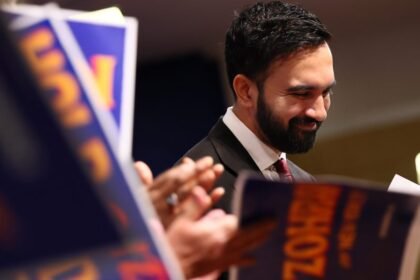
Abdul El-Sayed is the Democratic Party’s nominee for the Senate in Michigan after besting Rep. Haley Stevens by less than 1 percentage point. Not long after The Associated Press called the race on Wednesday morning, Stevens threw her “full support” behind El-Sayed. While the votes were still being counted on Tuesday night, state Sen. Mallory McMorrow — who had dropped out of the running in July — also endorsed her former opponent, acknowledging that despite a “brutal” primary race, what is most important now is to head into November as a “unified party.”
What remains to be seen is whether moderates and Democratic Party pundits will follow suit, get on board, and vote blue no matter who.
But centrists seem more interested in saving face than a Senate majority. Complaining that primary voters picked the candidate more likely to lose on Election Day has become a face-saving tactic for moderates as they’ve watched their preferred picks lose against upstart insurgent campaigns like El-Sayed’s.
Among them are The Atlantic’s Jon Chait, who’s never met a progressive candidate he won’t sneer at. In typical form, Chait concern-trolled last weekend over the potential that Democrats would lose Michigan’s Senate seat by picking the charismatic El-Sayed over Stevens.
“Is there a single el-Sayed supporter with enough self-awareness to admit they’re willing to accept a higher risk of defeat to elect a left-wing candidate?” Chait asked on X, citing polling showing Republican former Rep. Mike Rogers with a slight but consistent lead in the Senate race just outside the margin of error
A more honest commentator might have pointed out that El-Sayed beat back an establishment campaign with tens of millions of dollars behind it: a staggering $62 million poured into the state to boost Stevens, half of it from AIPAC, giving her and her allies a 9-to-1 spending advantage over El-Sayed. But honesty has seldom been important for Chait’s left-bashing.
Making sure donors and power brokers are confident their interests are still being represented fuels how some party hacks are waging war against the left flank.
By Wednesday morning, Chait had once again reframed the race, this time as a key battle in an existential war for liberalism. He groused variously about the streamer Hasan Piker, who campaigned for El-Sayed; democratic socialism; and James Carville.
“The left has played down every success by the establishment while forcing it to own every failure,” he wrote in The Atlantic. “This dynamic points to a broader asymmetry between the two factions. The mainstream liberals of the Democratic Party have focused their energies on defeating Republicans. The left-wing faction has focused on defeating them.”
Chait certainly understands that this is how power is accumulated in the Democratic Party but is upset that, for once, it’s not benefiting his wing.
He wasn’t alone. Matt Yglesias — the ubiquitous blogger whose self-styled branding as a sensible, middle-of-the road liberal belies his support for Israel and antipathy for trans people — had warned about El-Sayed’s ability to win in the general for months.
In a post on X citing one outlier poll showing Rogers with a 10-point lead on El-Sayed — the rest of the polls show a very tight race — Yglesias whined he was “kinda dooming on this situation.”
By early this morning, the blogger was downplaying the Michigan results, saying the Democratic nominee “should be good enough” to beat the Republican this year, even though El-Sayed “seems like a distinctly bad candidate” who is likely to “underperform the fundamentals.”
This is the kind of frustration that sets in when you realize that lurching to the right is putting you out of step with the party as whole, but you still want to be sure to appeal to the people who pay the bills.
Making sure donors and power brokers are confident their interests are still being represented fuels how some party hacks are waging war against the left flank. Center for American Progress president and CEO Neera Tanden’s war on El-Sayed, waged on X, her platform of choice, was prosecuted in shockingly bad faith, even considering the source. Tanden implied that El-Sayed is a toxic misogynist, said his campaign had a “serious sexism” problem, and went all-in on every single attack line that came out of the Stevens campaign and the special interests that funded it.
“If I was the El-Sayed campaign, I probably wouldn’t want to be associated with Platner advisors’ previous push for [Graham] Platner as a future President given that it sounds grotesque today,” Tanden said on July 9. She continued forebodingly: “But then again, his campaign has all the same advisors so maybe he will be next.”
El-Sayed’s detractors have powerful friends. The biggest money targeting El-Sayed comes from the American Israel Public Affairs Committee, which has already spent over $100 million on midterm races around the country, including more than $30 million directly boosting Stevens against El-Sayed.
That massive spending comes as no surprise for two reasons: First, El-Sayed has been a critic of Israel’s genocide in Gaza and the country’s conduct in general. Second, he’s of Egyptian descent, which is almost certainly a motivator for AIPAC, which didn’t throw much of any cash against Graham Platner, a white man in Maine, during his Senate campaign — despite Platner taking equally strong stances against Israel.
Instead, AIPAC bundled $538,000 in donations for incumbent Republican Sen. Susan Collins, and groups linked to its powerful super PAC pushed at least $750,000 into a state PAC opposing Platner. It’s a far cry from $60 million, but perhaps in the general election, Troy Jackson, who took over from Platner, will face larger financial attacks.
In the waning days of the campaign, Stevens leaned into her support from AIPAC, all but overtly accusing El-Sayed of being an antisemite. Many of her supporters, including Angie Smith, a school board secretary in suburban Detroit whose backing Stevens continued to celebrate, have engaged in the kind of blatant, ugly Islamophobia that’s been simmering for a decade but was at its height during the Bush and Obama presidencies. Smith went viral for saying in an interview: “Don’t come out speaking only Arabic. Don’t come out with your Arabic music on.”
Stevens herself spent the last week of the race emphasizing her Michigan roots, a clear comment on El-Sayed’s “otherness,” and hit her opponent with broadside dog-whistle attacks, tweeting at her opponent: “Everyone in America understands you want to blame all of your problems on Jewish Americans.”
The real issue is the ongoing struggle for control of the Democratic Party.
But while Israel and racism were undeniably motivating factors for some of El-Sayed’s Democratic naysayers, and will surely continue to be, the real issue is the ongoing struggle for control of the Democratic Party between the increasingly out-of-touch, more conservative establishment and the increasingly progressive, pissed-off base.
Over and over again in this primary cycle, progressive insurgents have defeated centrist picks — incumbent and otherwise — and even disasters like Platner haven’t stemmed the rising tide around the country.
Yet even in the context of a progressive insurgency, El-Sayed’s win is notable. He not only faced down AIPAC, but also nearly the entire weight of the entrenched Democratic establishment — and won. Stevens touted her backing by party leaders like South Carolina Rep. Jim Clyburn, Michigan Gov. Gretchen Whitmer, outgoing Sen. Gary Peters, and a host of local, state, and national leaders. Meanwhile, El-Sayed had the support of progressive party leaders, with Sens. Bernie Sanders and Elizabeth Warren and Rep. Alexandria Ocasio-Cortez, among many others, in his corner.
Now that El-Sayed is the party’s nominee, Stevens’s supporters, both in Michigan and nationally, will have to decide if they want a progressive Muslim in the Senate for six years or to risk continued GOP control. If they’re really worried about the outcome and truly committed to Democratic success in November, they’ll set aside whatever issues they have with El-Sayed and go all-in on his candidacy.
Any attempt to rationalize another way forward means that they’re more concerned with maintaining control over the levers of power of the party and disciplining their own voters. What they fail to realize is that you can’t enforce the iron law of institutions when there’s nothing to rule over.