

All France News
A rare archaeological site in the Sonoran Desert was bulldozed by a Department of Homeland Security contractor involved in building the latest sections of Donald Trump’s border wall, according to multiple sources briefed on the incident.
The area, in a remote corner of Arizona’s Cabeza Prieta National Wildlife Refuge, is a nearly 280-by-50-foot etching in the desert sand known as an intaglio.
Last Friday, without any notice, a contractor working for DHS cut a roughly 60-foot swath across the middle of the intaglio, doing irreparable damage to the 1,000-year-old artifact.
“I liken it to destroying the Nazca lines — something that culturally we should have been relishing and promoting.”
Cabeza Prieta, one of the largest wilderness areas outside of Alaska, also encompasses lands sacred to the Tohono O’odham Nation, which borders the refuge to the east. The O’odham have fought to prevent border wall construction across their reservation and during Trump’s first term largely prevailed; they also managed to protect the intaglio and a nearby burial site that they consider to be part of their ancestral lands.
“I liken it to destroying the Nazca lines — something that culturally we should have been relishing and promoting. Not destroying,” Rick Martynec, an archaeologist, said in a phone interview, referring to the hundreds of figures drawn into the deserts of southern Peru.
The destruction was confirmed by a federal employee with direct knowledge of the incident, who asked not to be named for fear of reprisal.
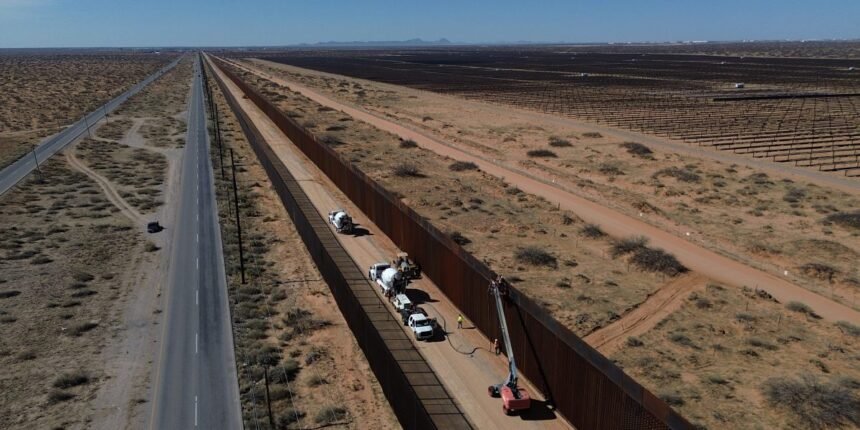
Well known to government officials, including the Interior Department’s Fish and Wildlife Service, which manages the refuge, the intaglio lies just 10 or 15 feet from the massive steel wall that now runs along the U.S.–Mexico border. The destruction to the ancient site was first reported by the Washington Post.
Rick and Sandy Martynec, his wife, also an archeologist who has studied the site for more than two decades, said the refuge was in talks with DHS and the contractor to make sure the site was protected as the Trump administration moves forward with a second set of barriers in the ecologically sensitive region.
The Martynecs even visited the intaglio in mid-April and observed stakes that had been put in place by an engineer to mark its boundaries.
The Martynecs were first notified by FWS staff on Monday when they called the refuge to see about visiting the site and to check on its status. According to the archeologists, Rijk Morawe, the refuge manager, had already been out to survey the damage and told them what had happened.
The news took the Martynecs and others by surprise, since the agency had been in dialogue with DHS and the contractor to come up with an alternative route that would avoid the intaglio, similar to the negotiations that had taken place during Trump’s first term. (DHS’s U.S. Customs and Border Protection in Arizona did not comment by press time. FWS declined to comment, referring all border inquiries to CBP.)
“The refuge was pushing as hard as they possibly could to come to a resolution,” Martynec said.
Members of the O’odham Nation had also been keeping a close eye on border wall development. On the day before the site was bulldozed, a group of O’odham runners observed construction getting dangerously close to the protected area. That morning they called Lorraine Eiler, an O’odham elder and co-founder of the International Sonoran Desert Alliance, who lives in the town of Ajo where the Cabeza Prieta Refuge office is located.
According to Eiler, the runners told her that the contractor was indiscriminately clearing the area. The contractor told her “they’re coming with their bulldozers and they’re knocking down trees and cactus and everything that’s along the border,” Eiler said. “They’re just bulldozing everything down and they are getting near the intaglio.”
Eiler made a round of phone calls to tribal officials and environmental groups, but the next day, the contractor moved in and destroyed the site.
“I alerted people but all I got was, ‘We’re going to have meetings, we’re going to discuss it,’” Eiler said.
During Trump’s first term, border wall construction had widespread impacts on protected landscapes and sacred sites. In one case, DHS blasted through several hills that were too steep to build on directly, including one in Organ Pipe National Monument, east of Cabeza, that was a well-known burial ground. A contractor also bulldozed a road through an archaic Hohokam burial site on the border in Coronado National Forest, even though they’d been briefed by the tribe beforehand.
“This doesn’t bode well for the desert.”
Border security continues to be a priority for the Trump administration, which has allocated more than $11 billion for new barriers and surveillance technology. The path that was cleared through the intaglio is part of an effort to build a so-called “smart wall” that CBP says will allow it to monitor activity in the desert day and night.
To do so, according to the Martynecs, the agency will have to clear a wide swath of land between the original wall and the secondary barrier.
“There won’t be any vegetation on it at all,” Martynec said. “This doesn’t bode well for the desert.”