

All France News
Tennessee Republicans are pushing forward with a bill that could force undocumented children out of public education and turn school administrators into immigration informants against their own students, making Tennessee the frontier of an effort led by the Heritage Foundation to fundamentally injure the right to public education.
The state’s proposed “trigger laws,” which will be heard in committee on Wednesday, are direct challenges to Plyler v. Doe, a narrowly decided 1982 Supreme Court case that enshrined the right to a free K–12 public education regardless of immigration status. The parallel bills would also likely violate federal statutes that codify the same right.
The Heritage Foundation, the conservative think tank behind Project 2025, has officially called on other states to pass similar laws challenging Plyler, situating Tennessee’s push as among the first in a broader national effort to overturn the decision.
“Illegal aliens should not be eligible for federal, state, or local government benefits, including through their children,” wrote Lora Ries, the director of Heritage’s Border Security and Immigration Center, in a February 17 post, “because the receipt of such benefits facilitates longer unlawful residence in the United States and takes resources from American citizens and lawful immigrants.”
So far, six states — Texas, Oklahoma, Idaho, Indiana, New Jersey, and Tennessee — have introduced bills that would violate Plyler. If passed, their implementation could force a challenge at the Supreme Court.
Educators and immigration advocates told The Intercept that if Tennessee and other states were to get Plyler overturned and enact legislation to track and potentially expel undocumented children from public school, it would “end public education as we know it.”
“This feels like a credible threat,” said Cassandra Zimmer-Wong, an immigration policy analyst at the Niskanen Center. “The ramifications of this are huge … denying children carte-blanche education would create an uneducated, potentially illiterate underclass of children and then adults in this country.”
Last year, the Tennessee state legislature introduced a bill, H.B. 793, that would allow schools to refuse to enroll students who cannot prove “lawful presence” in the United States or charge them tuition, but it was tabled due to concerns about potential federal funding losses because the law violated federal statutes. The bill would also require schools to report the number of students who enroll without a birth certificate. The Tennessee Senate version would allow schools to choose to deny enrollment to undocumented students only if they are unable to pay.
Now, the bill is back — and scheduled for a state House Finance, Ways, and Means Subcommittee hearing on Wednesday. A companion bill, which would require schools and other entities that receive state funding, like hospitals, to report to the government on recipients’ immigration status, moved out of committee last week. The second bill is also scheduled to be heard by the House State & Local Government Committee on Wednesday. It can only be enacted if H.B. 793 passes and Plyler is overturned.
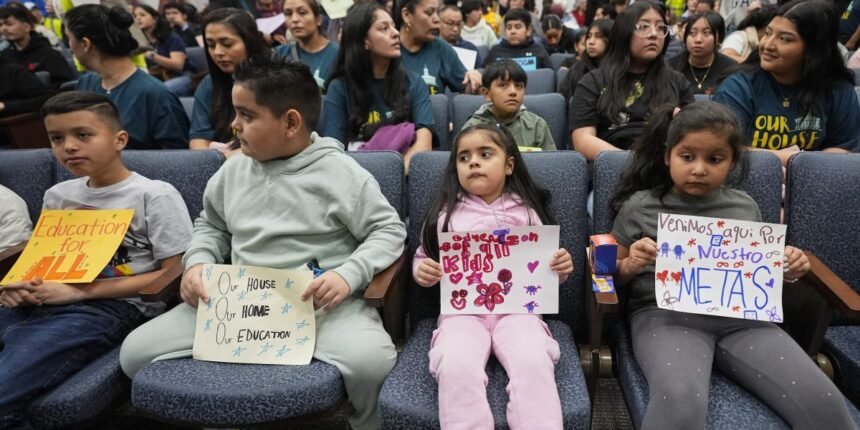
Sam Singer, a high school teacher who teaches English language learners in Tennessee, said she’s had “numerous students” who’ve heard of the bills ask if they’re still allowed to go to school.
“They’re questions that no child should ever have to ask, much less come to school and wonder about,” said Singer. “The expectation should be, of course, you’re supposed to be here, you’re a kid. This is where you belong.”
School should be a “safe space” for children, said Singer, “where you can trust that teachers are here to help you become your best self as you grow into the young adult you want to be.” Instead, the bills would effectively turn school administrators and teachers into immigration agents.
Across the state border in Texas, Republican Gov. Greg Abbott has said that he would seek to overturn Plyler for years. U.S. Rep. Chip Roy, a Republican Texas congressman now running for attorney general, has called for the 1982 ruling to be overturned as well.
“For illegal alien children, the Supreme Court said we have to fund education for them. The fact of the matter is that it is a massive tax burden on the people of Texas,” Roy said in an interview last week. “I don’t believe that the Constitution requires that the state of Texas should fund it, and we should make a new precedent by taking it to court.”
The Texas state legislature previously introduced two bills challenging Plyler. The first bill would allow public schools to charge undocumented children to attend, and the latter bill would require proof of citizenship to enroll in public school. Both of those bills have stalled, but Krystal Gómez, managing attorney for the Texas Immigration Law Council, said she expects more challenges to Plyler in the next legislative session.
“It used to be that we had a federal government in the Department of Education that didn’t seem interested in it, and was able to sort of put this to kibosh and have like a backstop to states that got a little out of hand in trying to create these chilling effects or overturn Plyler outright,” said Gomez. “We don’t have that now. So it’s sort of the wild, wild West, and whatever sad, terrible thing that a state can dream up, they can probably get away with.”
The Department of Education did not respond to a request for comment.
In Texas, immigrant student attendance has already declined dramatically since the start of Trump’s immigration enforcement ramp-up. The Houston school district lost nearly 4,000 immigrant students this year, a decline of roughly 22 percent of the school district’s immigrant population. It’s unclear how many of those students left the United States willingly, or were deported, and how many children still living in Houston are simply too afraid to return to classrooms.
The stress of constant raids weighs on many of the immigrant children still attending school, said Klara Aizupitis, 34, a high school English teacher in Terlingua, Texas.
“You’re living under the constant threat of either being picked up and deported or your parents or your siblings being picked up and deported,” said Aizupitis. “That stress is going to have an impact on, certainly, academic performance, but also your ability to manage your emotions in everyday life.”
“You’re living under the constant threat of either being picked up and deported or your parents or siblings being picked up and deported.”
Further eroding protections for immigrant students would devastate the border community where Aizupitis teaches. “We do really have a shared culture, on both sides of the [Rio Grande] river,” she said.
The district’s funding is based on average daily attendance, so losing undocumented students would “threaten the existence of our school district,” said Aizupitis. “Moreover, it would threaten the existence of our entire community.”
An estimate from FWD, a criminal justice and immigration policy organization, found that undocumented students would lose a collective $1 trillion — or 600,000 individually — in lifetime income if they were denied access to public education.
Heritage frequently suggests that undocumented students represent a substantial burden on taxpayers, arguing in a statement to The Intercept that “unaccompanied alien children sent to states cost them hundreds of millions of dollars for one year of public education.” But according to the Institute on Taxation and Economic Policy, undocumented people in the U.S. pay nearly $97 billion in federal, state, and local taxes annually. Tax contributions from undocumented people far outweigh the financial burden of K–12 education for undocumented children.
The Heritage Foundation’s argument, said Zimmer-Wong, “does not hold up to any kind of basic scrutiny.”
The FWD report found that educating undocumented students provides $633 billion more money in state and local income tax contributions than the cost of their education. The report also found that, if Plyler were overturned, the U.S. workforce would decrease by 450,000 workers in critical jobs that require at least a high school or college education.
None of that accounts for the expense of implementing a widespread immigration surveillance system in schools. “It would be extremely costly,” said Lisa Sherman Luna, executive director of the Tennessee Immigrant and Refugee Rights Coalition.
Schools would have to acquire “new software, new computers, new administrative processes and staff” to track and determine the immigration status of the tens of thousands of children within any given school district, not just students who are undocumented, she said.
“The Heritage Foundation reports notes the burden placed on schools, [from undocumented children],” said Ignacia Rodriguez Kmec, policy council at the National Immigration Law Center, “yet their solution is for school personnel to become essentially DHS and TSA agents, verifying, reviewing documents, and recording immigration status.”
“Their solution is for school personnel to become essentially DHS and TSA agents.”
The Heritage Foundation pushed back on criticism of its plan, telling The Intercept that undocumented children would still have the option to receive an education — if they paid tuition, self-deported, or left the state.
“These are the consequences for the decision the parent or student made to break our law. American taxpayers should not have to pay for law breaking. Nor can American taxpayers afford it,” Ries wrote in a statement to The Intercept.
Thomas A. Saenz, president and general counsel of the Mexican American Legal Defense and Education Fund, which originally litigated Plyler, said that he doesn’t believe the Supreme Court will allow these bills to be implemented. Because the bills would violate federal statutes, they would run up against the supremacy clause of the Constitution, Saenz pointed out.
However, if the courts were to look favorably on a challenge to Plyler and its corresponding federal statutes, Saenz said, the consequences would be devastating.
“It would have the impact of ending public education as we know it, because when a certain cohort of kids is allowed to be out of school, what happens next is that their siblings and friends don’t go to school,” Saenz said, “and rapidly, no one goes to school.”