


All France News
The House of Representatives is set to vote Wednesday on renewing a spy power that grants the Trump administration warrantless access to thousands of Americans’ communications.
While uniting against President Donald Trump on many fronts, Democrats are split on what to do over the domestic spying power — and the party’s leadership isn’t giving much guidance, according to a congressional notice obtained by The Intercept.
Clark gave straight up-or-down recommendations on many other pieces of legislation, but not the spying law.
In the notice laying out leadership’s advice on bills up for a vote this week, Democratic Whip Katherine Clark simply explained that the relevant top committee leaders were split. House Intelligence Committee Ranking Member Jim Himes supports a clean reauthorization of the Foreign Intelligence Surveillance Act, while Judiciary Committee Ranking Member Jamie Raskin wants further reforms.
Clark gave straight up-or-down recommendations on many other pieces of legislation, but not the spying law.
With leadership silent, progressive activists are trying to step into the void to pressure members. They say Trump’s disregard for the rule of law in his second term means that representatives should only vote for the law with reforms. Government officials have engaged a pattern of abuses at the Justice Department.
Centrists on two key committees, on the other hand, say that modest changes enacted in 2024 went far enough and Congress should give Trump the so-called “clean” reauthorization he has requested.
“They, I don’t think, have a stance on this,” Jake Laperruque, deputy director of the Center for Democracy and Technology’s security and surveillance project, said of the Democratic leadership. “I would hope the gutting of oversight systems and what we have seen at DOJ and politicization there would push them against that — but we don’t know yet.”
With Republicans themselves divided, the margin within the Democratic caucus could prove crucial.
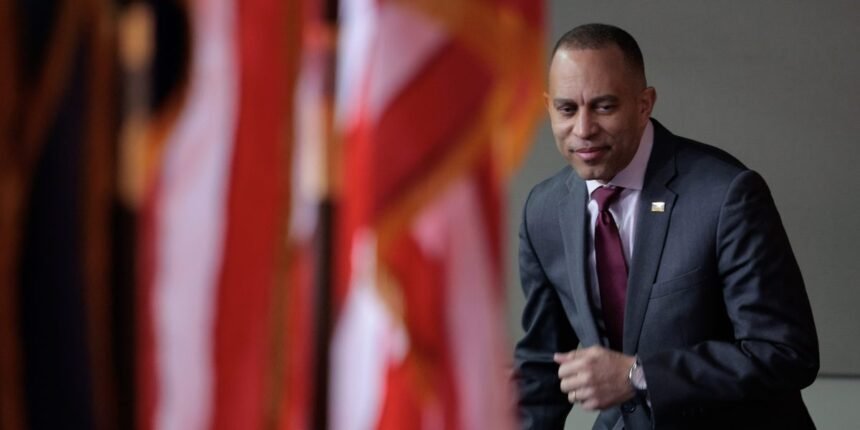
Rather than advising members how to vote, however, Democratic leaders is stepping aside. House Minority Leader Hakeem Jeffries, D-N.Y., has said that he personally supports reforms but has not signaled that he will pressure his caucus. (Jeffries’s office did not immediately respond to a request for comment.)
The debate concerns Section 702 of the Foreign Intelligence Surveillance Act, which last came up for renewal in April 2024.
The law allows intelligence agencies to hoover up ostensibly “foreign” communications, such as text messages and emails, and then search them for information about Americans. Intelligence agencies conduct thousands of these “backdoor” searches every year.
Safeguards are supposed to ensure that the National Security Agency and FBI are only searching for information on genuine national security threats. Past reviews of the program have regularly found violations, however, including instances where spy agencies searched for information on Black Lives Matter activists and even members of Congress.
During the last reauthorization, Congress enacted a handful of reforms meant to put tighter rules into place for when intelligence agencies can search through the collected data, and to ensure that there are more after-the-fact audits. Since then, a review by an inspector general found a steep decrease in the number of apparent violations.
Supporters of a “clean” reauthorization say those reforms went far enough. Opponents say they still want Congress to force intelligence agents to go to a court to ask for a warrant.
Grassroots Opposition?
Progressive groups are trying to exert grassroots pressure. They targeted Himes, the centrist supporter of the “clean” renewal, at a town hall in his district last month, asking him to withdraw his support for the spying law.
Himes, however, has not budged, saying that he is confident that there have been no abuses under Trump. For his part, Himes is lobbying his fellow members: He convinced House Foreign Affairs Committee Ranking Member Gregory Meeks, D-N.Y., to support a clean reauthorization.
On the other side of the debate, Raskin has pointed out that Trump has gutted key oversight bodies, including the Privacy and Civil Liberties Oversight Board. Advocates have also pointed more recently to a secret court opinion, reported by the New York Times, which found significant problems with how the government is tracking its searches of information about Americans.
“These models give a lot of leverage to analysts working inside the national security establishment.”
Prior FISA renewal fights have rarely drawn the kind of in-person, grassroots activism on display at the Himes town hall. Advocates said that what has changed this time around are growing concerns about how spy agencies can use artificial intelligence to search through reams of information on foreigners and Americans.
“These models give a lot of leverage to analysts working inside the national security establishment,” Dave Kasten, the head of policy at the AI safety nonprofit Palisade Research, said on a call with reporters on Tuesday, “which certainly can be both a good thing and a bad thing, depending on the uses to which they are put.”
Further fueling those concerns is the fact that federal intelligence agencies increasingly rely on information obtained through commercial data brokers, which the government contends does not require a warrant even when it pertains to U.S. citizens.
Aside from committee leaders, the FISA reauthorization fight has also split some of the powerful Democratic caucuses.
The Congressional Black Caucus is poised to support a “clean” reauthorization, The American Prospect reported Monday. The caucus did not respond to a request for comment.
In contrast, the chairs of the Congressional Asian Pacific American Caucus, the Congressional Hispanic Caucus, and the Congressional Progressive Caucus released a letter on Tuesday calling for “meaningful” reforms.
In addition to a warrant requirement for “backdoor” searches, progressives are also pushing to limit when and how intelligence agencies can use information obtained from commercial data brokers.
House Speaker Mike Johnson, R-La., has pointed to the pending April 20 expiration of Section 702 as the reason that Congress needs to urgently renew the law. Progressives, though, pointed out that the Foreign Intelligence Surveillance Court effectively provided the spy agencies with a yearlong extension of their spying powers, regardless of what Congress does.
In a rare cross-chamber letter on Monday, Sen. Ron Wyden, D-Ore., urged representatives to wait before reauthorizing the program.
“[T]here are multiple issues related to Section 702 that the American people and many Members of Congress have been left in the dark about,” he said, “including a FISA Court opinion from last month that found major compliance problems. These matters should be declassified and openly debated before Section 702 is reauthorized.”