

All France News
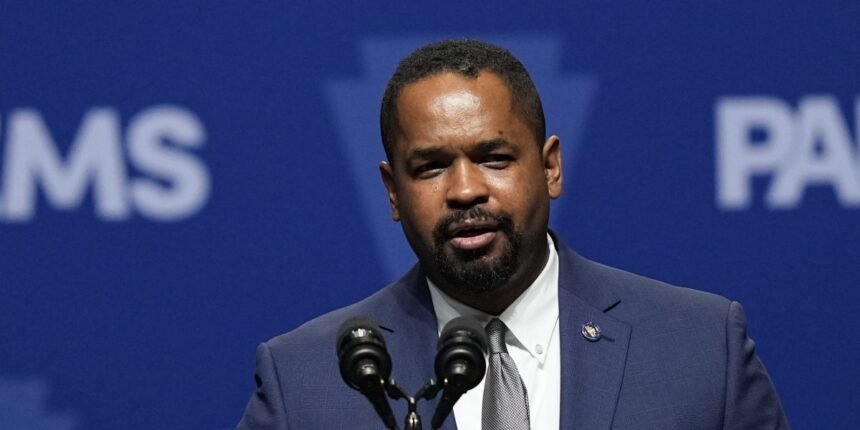
Sharif Street is something of an anomaly. A Democratic state senator running for Congress, he’s angling to replace retiring Rep. Dwight Evans in a deep-blue Philadelphia seat. He’s Black, Muslim, and relatively moderate. He would not necessarily be a vocal critic of Israel in the House.
Street is walking a fine line on Israel policy, articulating views that range from moderate to evasive. That has rankled some of Philadelphia’s progressive Muslim organizers, but it may well reflect an effort to appease the city’s diverse voting blocs. Philadelphia’s large Muslim and Jewish populations don’t fall neatly on either side of issues related to Israel and Gaza, and Street’s supporters and detractors alike argue that they don’t want identity politics to overshadow substantive policy debates.
Many Muslim Philadelphians “may like Street personally,” said Yusuf Abdul Hameed, a member of the Philadelphia chapter of the Council on American-Islamic Relations, “but they’re upset because of his lack of courage to really condemn Israel for what clearly was a genocide.” Hameed counted himself among those who like Street, but he said he’s backing his opponent, Pennsylvania state Rep. Chris Rabb, a progressive who has carved out a lane on the left by being openly critical of Israel’s genocide in Gaza.
Their competition now stands to turn Philadelphia into a testing ground, where voters have a chance to signal how much Israel and Palestine still matter to them as the Trump administration’s barrage of constant scandals, crackdowns, and excesses dominates the midterms cycle.
Street doesn’t have Israel policies on his campaign website. His stance on the issue has largely come to light through public statements he made in his former role as chair of the Pennsylvania Democratic Party after the October 7, 2023, attacks and over the course of the campaign. His current vagueness has raised questions about whether he would accept campaign funding from the American Israel Public Affairs Committee or other factions of the pro-Israel lobby.
“I recognize that there won’t be peace for the state of Israel without peace for the Palestinian people, but there won’t be peace for the Palestinian people unless there’s peace for the state of Israel at some point,” Street told the Philadelphia Inquirer last month.
Street supporter Salima Suswell, an organizer in Philadelphia’s Black Muslim community, said Street had been a leader for Muslims in the city and in the district and also spoke out on Gaza. She said Street and other Black Muslim officials can face a greater pressure to choose sides between Israel and Gaza but that she was confident in Street’s ability to listen to and act on the needs of residents in the district.
“That said, the Black Muslim community stands in solidarity with our sisters and brothers in Gaza. I fully trust that Senator Street will be a force for good in Congress, and he will fight for our communities both domestically and abroad,” she said.
Home to one of the largest Muslim populations in the country, Philadelphia has a sizable community of Black residents who converted to Islam in the 1960s, during the rise of Malcolm X and the Nation of Islam. The city is also home to many Jewish voters, including younger ones who are more likely to be critical of Israel than the older generation, as well as moderate, pro-Israel Jewish Democrats who make up a large portion of the voting bloc.
The political complexities of Philadelphia’s religious electorate could make things difficult for AIPAC, which has been searching for ways to shape midterm races this cycle without drawing too much negative attention to itself.
AIPAC has not publicly endorsed in the 3rd Congressional District race. But Street was the beneficiary of a short-lived, secret fundraising page hosted by a little-known pro-Israel group — one that AIPAC has used to direct donors to at least one other candidate this cycle.
The fundraising page, hosted by the Pro-Israel Network, urged donors to contribute to Street’s campaign. The page was live until late last year, when it came to the attention of Philadelphia’s progressive circles and suddenly vanished. The Pro-Israel Network is not officially affiliated with AIPAC. But as AIPAC has adopted a quieter role in elections this cycle, the Pro-Israel Network is one of several proxies the more prominent group has used to highlight preferred candidates for its donors.
Street’s campaign said in a statement to The Intercept that they weren’t aware of the page until it was brought to their attention and that they didn’t seek the group’s endorsement or receive any campaign contributions through the page.
“Sharif is not seeking AIPAC’s endorsement, and we weren’t aware of the Pro-Israel Network page until folks showed it to us. We didn’t coordinate with that group and haven’t received any funding from it,” Street’s campaign spokesperson Anthony Campisi said.
Beth Miller, the political director for Jewish Voice for Peace Action, said she hopes the Street campaign will keep it that way.
“Pro-genocide groups like AIPAC are directly at odds with what Democratic voters want. The overwhelming majority of Democratic voters have made it clear that they want the U.S. to stop funding Israel’s atrocities against Palestinians,” Miller said. “No Democratic candidate should be taking a dollar — or any other kind of support — from groups that are so at odds with the party’s own base.”
According to Ahmet Selim Tekelioglu, the executive director of CAIR-Philadelphia, many in the Philadelphia community view the issue of Israel and Palestine as a window into broader debates, and they see reason to be wary of politicians who waver from moral stances.
“The Israel–Palestine issue is not only important as a foreign policy matter, but also as an issue that intersects with rights, with freedoms, with how we stand up for oppressed people in our own communities in the U.S.,” Tekelioglu said. He said Philadelphians “are now asking for more, and are coming closer to an accountability politics point of view.”
As a nonprofit, CAIR-Philadelphia cannot endorse a candidate, but Tekelioglu said he’s volunteering for Rabb in his personal capacity. The national political arm, CAIR Action, plans to endorse in the race but has not yet announced its pick.
Hameed, who has been a member of the Nation of Islam since the 1980s, said it would be nice to have a Muslim representative in Congress, but sharing race or religion with a candidate wasn’t enough to earn his vote. He criticized attempts to make excuses for Black Democrats who have taken support from AIPAC, like Reps. Hakeem Jeffries and Ritchie Torres of New York and Glenn Ivey of Maryland.
“These people support Israel, and they’re getting money from AIPAC, and they’re complicit with genocide,” Hameed said. “They would turn on them in a dime.”
During a candidate forum in December, Street was asked whether he would support legislation to block arms sales to Israel. He said peace and security relied on getting humanitarian aid into Gaza and rebuilding, but that his allotted response time wasn’t enough to answer the question or address such a complicated issue.
“If we’re gonna do this topic justice, talking about peace in the Middle East is not really a one-minute answer,” Street said. “Catchy soundbites sound good, but they don’t save lives.”
“Talking about peace in the Middle East is not really a one-minute answer.”
While several candidates criticized Israel’s destruction in Gaza, Rabb was the only one of the five candidates present to state specifically that he would support such legislation. During another forum in January, Rabb was also clear on his stance on the leading pro-Israel lobbying group, saying, “Fuck AIPAC.”
Street and Rabb are running in a crowded field of more than 10 candidates vying to replace Evans in the May 19 primary. Among them are state Rep. Morgan Cephas, Dr. David Oxman, Dr. Ala Stanford, climate adviser under former President Joe Biden Pablo McConnie-Saad, and real estate developer and nonprofit leader Isaiah Martin. Street is leading the pack in fundraising, with more than $700,000 raised so far. Oxman has raised $497,000 — including $175,000 he gave to his own campaign. Stanford has raised $467,000, and Rabb has raised $384,000, ahead of Cephas, who’s raised $241,000.
Muslims United PAC, a national political action committee that has endorsed candidates including Reps. Rashida Tlaib, Ilhan Omar, Alexandria Ocasio-Cortez, and Summer Lee, endorsed Rabb over Street, mainly because of Rabb’s explicit criticism of the genocide in Gaza. The group declined to comment on the race.
In a statement to The Intercept, Rabb said he couldn’t speculate on who was backing his opponents but that he would never take money from AIPAC. “I have not nor would I even consider meeting with AIPAC because I view them as a racist, extremist organization,” Rabb said.
“Israel and Gaza — and Palestine, more broadly — deserve the opportunity to engage in peaceful self-determination without U.S. military domination preempting that fundamental right. I support a permanent and immediate ceasefire including release of hostages, recognition that a genocide has occurred in Gaza, and oppose export or use of U.S. weapons in ways that violate U.S. or international law,” he said. Rabb is also running on rejecting corporate PAC money, fighting the influence of billionaires in politics, and abolishing Immigration and Customs Enforcement.
The Pro-Israel network funding page, a sign that the lobby has its eyes on the race, is a point of contention among critics who say AIPAC shouldn’t be getting involved in races at all, let alone one in a district which Democrats are largely to the group’s left on policy toward Israel and Gaza.
“AIPAC is a red line,” said Saleem Holbrook, executive director of Philadelphia’s Abolitionist Law Center, a public interest law firm that advocates for criminal justice reform that has worked with Street on state reform efforts in Pennsylvania.
“There’s no way that our organization or many progressive organizations are going to back any candidate that takes AIPAC support,” Holbrook said. “Because when you look at AIPAC’s track record, all AIPAC has done has taken out Black progressive politicians or candidates that had the interest of the Black community in their heart.”
Suswell, the Street supporter, agreed that the race should be about policies that support the community, pointing to affordable housing, quality education, and public safety. “This should not be about identity politics,” she said. “This is about track record. Senator Street has an impeccable track record in his district and across the Muslim community.”
Progressive groups have been slowly endorsing Rabb, and two sources with knowledge of the race said it’s only a matter of time before they consolidate behind him. Rabb has been endorsed by Philadelphia’s chapter of Democratic Socialists of America, Sunrise Movement’s national and Philadelphia chapters, One PA, and Mt. Airy Democrats.
Both Street and Rabb are actively seeking the endorsement from the Working Families Party, which is planning to announce its pick in the next few weeks. So are CAIR Action and A New Policy.
While Street may not have the backing of leading progressive groups in Pennsylvania, he does have good relationships with their members. That dynamic is one reason progressive groups have taken their time to make endorsements in a race pitting their allies against one another, according to one source close to the race.
Street is endorsed by the Philadelphia Democratic Party, the Muslim League of Voters of the Delaware Valley, and several of Philadelphia’s powerful labor unions including Philadelphia’s powerful Building and Construction Trades Council, which encompasses several local shops. He’s also backed by former Pennsylvania Gov. Ed Rendell, Philadelphia Sheriff Rochelle Bilal, advocates for gun violence prevention and several prominent leaders for LGBTQ rights.
Street’s campaign pointed to his work advancing religious rights for Muslims in the district, helping to expand healthcare for Pennsylvanians, leading the fight to legalize recreational cannabis and reform the criminal justice system, and protect voting rights. “He’s going to bring that same drive to Washington, where he will be relentlessly focused on lowering costs, expanding health care access, reforming our criminal justice system, and holding Trump accountable,” said Campisi, his spokesperson.