

All France News
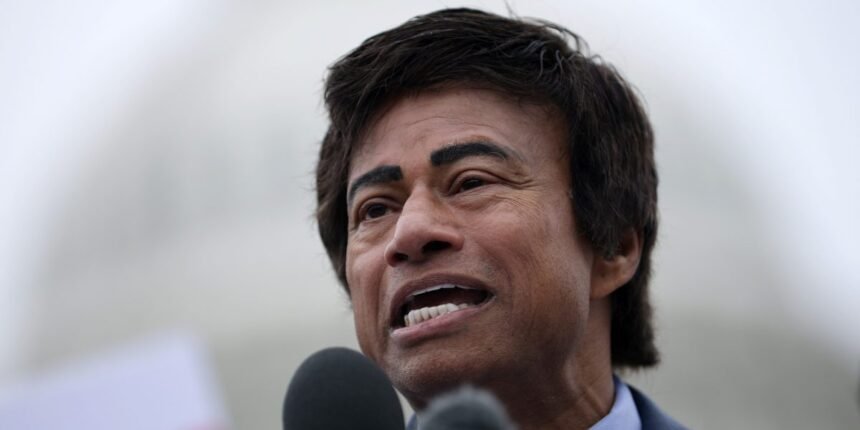
Rep. Shri Thanedar, D-Mich., lost more than $630,000 in investment income last quarter after he put $3.7 million in campaign funds into the cryptocurrency industry, according to a new filing with the Federal Election Commission released on Wednesday. Amid those losses, bundlers from the American Israel Public Affairs Committee have stepped in to prop up his campaign.
Two-thirds of the money Thanedar raised in the last quarter came from AIPAC, which collects money from multiple donors and funnels it to the pro-Israel group’s preferred candidates, according to his campaign’s most recent FEC filing. Less than a quarter of those donors listed Michigan as their state of residence. Thanedar, who is facing a challenge from a democratic socialist in next month’s Democratic primary, was in the minority of House Democrats who voted against cutting $3.3 billion in military aid to Israel from a State Department spending bill this week.
“That’s a lot of money for a campaign to be losing, especially when the market is at record highs.”
“They’re not raising a lot of money from donors at this point,” said Brendan Glavin, director of insights at the watchdog campaign finance group OpenSecrets, about Thanedar’s filing. Asked about the investment losses Thanedar listed in the filing, Glavin said, “That’s a lot of money for a campaign to be losing, especially when the market is at record highs.”
Thanedar — who has made his money building, buying, and selling off companies — has heavily self-funded his campaign to stave off Donavan McKinney, a Michigan state representative aiming to maintain a wave of socialist success that’s seen challengers from the left topple establishment favorites in New York, Pennsylvania, and Colorado so far this midterm cycle. Thanedar gave himself $800,000 in June, the latest in more than $12 million he’s loaned his campaign since he first ran for Congress in 2021. He outraised McKinney last quarter, though Thanedar’s campaign carries his personal loans as debt.
In his most recent campaign filing, Thanedar reported more than $3.9 million in investment income losses this cycle.
The August 4 Michigan primary is among the next races to pit a democratic socialist candidate against an incumbent. McKinney — whose endorsers include Justice Democrats, the Working Families Party, the Metro Detroit chapter of Democratic Socialists for America, several major unions, and Sen. Bernie Sanders, I-Vt. — is running on Medicare for All, the Green New Deal, a national homes guarantee, opposing President Donald Trump’s war on immigrants, and ending military aid to Israel. He has hit Thanedar for buying his seat in Congress, paying campaign expenses with taxpayer money, and spurning his constituents.
Deep-pocketed donors “get a massive return on investment when Shri Thanedar votes with 99.9% of Republicans and against a majority of Democrats to keep spending our taxpayer dollars funding Israel’s genocide, or when he votes for Trump’s crypto corruption, or even when he simply refuses to answer his constituent’s calls during a crisis,” said Justice Democrats spokesperson Usamah Andrabi, calling Thanedar’s service in Michigan’s 13th Congressional District “representation for the 1% at the expense of one of the poorest districts in the country.”
“We cannot be the party of the working class when we’re represented by multimillionaires, bankrolled by AIPAC donors, doing the bidding of corporate interests,” he added.
It’s not unusual for candidates to put campaign funds into investment vehicles, but Thanedar’s decision to invest campaign funds in the cryptocurrency industry in 2024 was notable, said Glavin. At the time, the pro-crypto lobby was ramping up its spending on elections.
“There are examples of candidates who have lost significant funds in putting their money into the market,” Glavin said. “But you’re usually going to find that they’re going to put it in something a little less volatile than the crypto market.”
The campaign’s investment losses were only partly offset by contributions from AIPAC bundlers. Glavin said the debt incurred from Thanedar’s loans to the campaign and the share of his most recent fundraising haul boosted by AIPAC suggest the campaign isn’t doing much on the fundraising front.
“It’s not like the campaign is actually going out and soliciting those funds,” he said.
Thanedar was a target of AIPAC during his first congressional run; the group endorsed his opponent and its super PAC spent millions against him in 2022. Since then, however, Thanedar has faced scrutiny for his increasingly cozy relationship with the pro-Israel lobby. AIPAC endorsed him during his 2024 reelection campaign, and a pop-up political action committee funded by AIPAC’s super PAC spent more than $2 million against his opponent that cycle.
The Michigan congressman is featured on AIPAC’s political portal for donors, which it uses to funnel contributions to its preferred candidates. As the primary election nears, Thanedar’s critics have recirculated a video he filmed while on an AIPAC trip to Israel in 2023. His campaign did not respond to a request for comment.
Thanedar is facing a potential upset as some members of the Congressional Black Caucus reportedly consider endorsing McKinney against him — an unusual move given that the group tends to side with incumbents. Outside groups have spent just over $2 million on the race so far, all backing McKinney or opposing Thanedar. It’s not clear whether any other groups plan to spend for Thanedar in the final weeks of the race.
In May, Thanedar requested an extension on this year’s financial disclosure until August 13, after the primary. Members of Congress are required to file reports each May, though it’s not necessarily unusual to ask for an extension. Thanedar also filed his last disclosure in August.
At the end of 2025, Thanedar reported to the FEC $11.5 million in debt from loans he’s given his campaign since 2021, when he first ran for Congress and initially loaned himself $5 million.
It’s becoming more common for candidates to spend upward of $1 million self-financing their campaigns, Glavin said. The massive spending of personal wealth became less risky after a 2022 Supreme Court ruling lifted limits on how much campaigns can spend to pay back a loan from a candidate.
Before, candidates understood themselves to be on the hook for the money they use to self-finance, Glavin said. Now, they figure that with the power of incumbency, “I can start raising money, and then I build up a donor base, and then I can get some of that money back, even if it’s five, six years down the road,” Glavin said. “A campaign committee can carry that debt for any amount of time.”