

All France News
There are two democratic socialists running for mayor in Los Angeles, but many West Coast leftists are already feeling the crush of defeat.
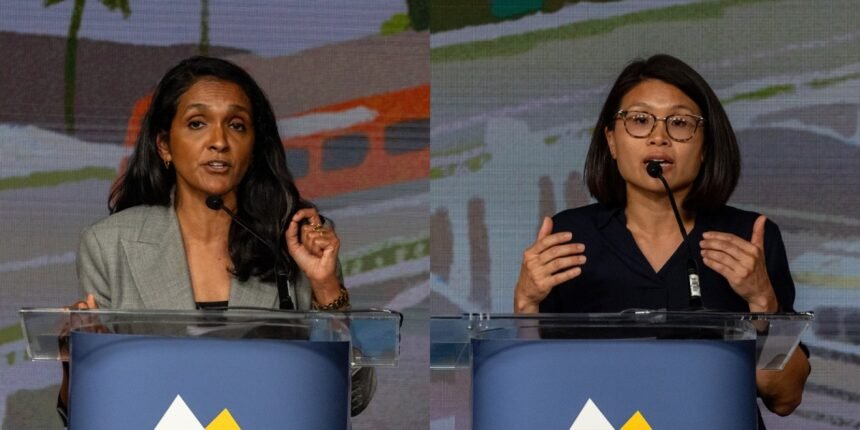
Rae Huang and Nithya Raman have each, at varying times, been hailed as Southern California’s analogue to Zohran Mamdani. Yet when the rallies and canvassing sessions have wrapped up, leftists admit that neither has the coalition nor the talent that fueled the New York City mayor’s rise. Huang voices the platform they like; Raman has demonstrated some political chops. Mamdani won because he had both.
With less than a week to go before election day in a crowded nonpartisan primary, Huang, Raman, and 11 other candidates are all vying for second place to the presumed front-runner, incumbent Democratic Mayor Karen Bass. Unless someone gets over 50 percent of the vote, the top two candidates will advance to a runoff in November.
There’s little chance either slot will go to Huang, a Presbyterian minister and activist who jumped into the race last November with plans to run from Bass’s left by campaigning on free buses, affordable housing, and police accountability. She has struggled to break 10 percent in the polls.
Raman, a city councilmember representing a sprawling district that spans the Los Feliz, Hollywood, and San Fernando Valley neighborhoods, surprised her allies and opponents alike when she joined the race just hours before the February filing deadline, but she has since amassed enough support that she could conceivably compete with Bass — or with Spencer Pratt, a right-wing reality TV star whose candidacy has fractured the city’s already divided left.
In the eyes of some leftists, a vote for Raman is the pragmatic choice to stop Pratt from making it to November, and a vote for Huang is a throwaway in the name of ideological purity.
Pratt has built a campaign attacking Bass’s handling of the Pacific Palisades fire, calling unhoused people drug-addicted “zombies,” and arguing that LA’s housing crisis should be solved with police force. In the eyes of some leftists, a vote for Raman is the pragmatic choice to stop Pratt from making it to November, and a vote for Huang is a throwaway in the name of ideological purity.
“While I understand the desire to vote for the most value-aligned candidate,” said Leslie Chang, a Raman supporter and co-chair of the Democratic Socialists of America–Los Angeles, “if it comes at the cost of everyday people being able to live a better life, that’s not something I have sympathy for.”
Huang’s supporters, meanwhile, argue that Raman’s platform offers little daylight from Bass, whose status quo gave rise to Pratt in the first place.
“Those who consider themselves progressive, or even on the left, have kind of gone into retreat and not let themselves imagine a better political future,” said Michael Burns, a writer and performer who mailed in his vote for Huang. “And for me, supporting candidates with a bold vision, with a left vision, is part of contributing to that imaginary.”
Though both Huang and Raman are Democratic Socialists of America members, the local chapter has not endorsed either candidate, and Raman’s three DSA colleagues on the City Council have endorsed Bass. Huang and Raman’s campaigns did not respond to The Intercept’s requests for comment.
Despite being a DSA member, Nithya Raman has at times aligned herself with more conservative forces and struggled to build coalitions on the left. After running in 2020 on calls to defund the police, she voted to expand the Los Angeles Police Department budget in 2021, 2022, and 2023. But she also voted against police raises in 2023, and this year, she opposed a plan by Bass to hire 170 more officers. In 2024, Raman accepted an endorsement from the Democrats for Israel–Los Angeles, a Zionist organization that opposed a ceasefire in Gaza, which earned her a censure from DSA–LA.
“I don’t know what version of Nithya I’m ever getting on anything,” said William Gude, a Hollywood resident. Known as @FilmthePoliceLA on social media, Gude is a fierce police accountability advocate who said he would have voted for Raman had she maintained her policy positions from her rise to City Council in 2020. Now, he says he finds it difficult to get responses from Raman’s office regarding police misconduct.
Raman’s supporters argue that at least their candidate has a political record to scrutinize. Huang has never held elected office, and her lack of campaign experience has shown itself on the trail. Earlier this week, the LA Reporter exposed that the Huang campaign had misrepresented its fundraising totals by claiming publicly that Huang had raised enough to qualify for public matching funds, when in reality she’d fallen far short. (The campaign has chalked the mistake up to clerical errors and lack of capacity.)
“The reason why I’m not voting for Rae Huang is kind of like a pragmatic approach and a belief that change comes incrementally,” said Sean Wakasa, who co-chairs DSA–LA along with Chang. “You have to make a power analysis about what’s achievable and what’s likely to happen, and that’s what keeps my vote for Nithya going strong.”
The most recent poll in the race, released from the Los Angeles Times and University of California, Berkeley on Thursday, has only increased the stakes. It shows Raman in striking distance of Bass, with 25 percent support to the incumbent’s 26, and ahead of Pratt, at 22.
In the eyes of the most ardent Raman backers, Huang’s voters, who made up 9 percent of respondents, are both delusional and important. Raman supporters call for Huang to drop out and for her voters who have yet to cast their ballots to jump ship. But not all leftist Raman skeptics favor Huang: Roughly 10 percent of voters remain undecided. Gude said he’s considering sitting this election out.
Raman also has a tendency to struggle during debates and public conversations; in an appearance on influential political commentator Hasan Piker’s stream earlier this month, she stumbled over questions about the sale of property in illegal West Bank settlements and the LAPD’s training collaboration with the Israeli military. Combined with the Huang campaign’s messy rollout, it’s possible neither candidate is quite spotlight-ready to command an audience the size of LA.
Leftist, liberal, and moderate Angelenos alike fear there’s someone else who is.

You might have seen Spencer Pratt on television 20 years ago, screaming “What are you crying about, Stephanie?” and calling his little sister, the target of his ire, a “crazy bitch.” He made millions on the reality TV show “The Hills” — then blew most of it on crystals, expensive wine, and other luxury habits. His campaign, too, is predicated on the idea of great personal loss: His platform centers the destruction of his home in the Palisades fire, for which he blames Bass (and not climate change, which, on one of many podcast appearances with conspiracy theorist Alex Jones, he implied was a hoax).
Pratt, who did not respond to The Intercept’s request for comment, has sought to paint himself as a regular guy fed up with the corruption of “elites” like Bass and Raman, and desperate to get the “bums” off the street. In one ad, he stands in front of an Airstream trailer, where he claimed to be living after his house burned down. (He was actually staying at the Hotel Bel-Air for over $1,000 a night.)
His situation has not translated into a drop of empathy for the people who actually cannot afford homes. “This idea that they’re forced on the street right now is a lie that our city is perpetuating,” said Pratt during a local ABC interview, referencing the city’s unhoused population. He has claimed they are on “super meth,” and argued that they don’t want to go into shelters, in part, because they want to continue to “abuse” animals on the street. Pratt has said that if elected, he plans to have police “arresting people and the people that aren’t getting arrested, we’re getting to mandatory medical treatment.” He argued that whoever was left would go to Seattle once his administration stopped providing resources and housing services — or, as he called it, “unplug them.”
Those “talking points” are “disconnected from the data and the reality of the situation,” said Benjamin Henwood, director of the Homelessness Policy Research Institute at the University of Southern California. Homelessness has nearly doubled in Los Angeles over the last decade, though it’s dipped slightly in the last couple of years. “We know from research and data that [homelessness] really is driven by housing affordability.”
The idea that Los Angeles has enough beds, and people just don’t want to use them, is belied by the available data. As of 2023, an audit from the LA city controller’s office found that roughly 46,260 unhoused people live in Los Angeles, but there were only 16,000 interim shelter beds available. And while the city has added some new beds since then, Henwood said they’re not nearly enough for everyone.
“That’s one of the most expensive ways to try to address homelessness.”
Substance abuse and mental health problems are also not the main drivers, though they are often the most noticeable to the general public. And it’s not clear if Pratt’s arrest-first strategy would even be legal, Henwood said. But, “practically speaking, that’s one of the most expensive ways to try to address homelessness,” said Henwood. “It uses a huge amount of resources, and at the end of the day, people can only be incarcerated for short periods of time, and then they’ll have to be released. So I don’t actually know how that translates into any kind of longer term goal, but it does spend a lot of public tax dollars.”
Matthew Lewis, director of communications at California YIMBY, an organization that pushes for more development of high-density housing to solve the housing crisis, argues that Pratt, who he vehemently disagrees with, and the wave of anti-homeless legislation across the country is a reaction to policy failures in Democratic cities to adequately address the housing crisis. “You see the same thing play out all over the place,” he said, “and what that suggests is that this is not a Spencer Pratt phenomenon, this is an American city phenomenon. Spencer Pratt is a consequence of pretending we could brush it under the rug.”
“This is not a Spencer Pratt phenomenon, this is an American city phenomenon.”
But Bass has been the subject of LA-specific grievances. She faced intense scrutiny for her handling of the twin Pacific Palisades and Eaton fires, which destroyed thousands of homes and killed dozens of people. Despite promising not to travel abroad during her tenure as mayor, Bass was in Ghana attending an embassy party when the fires broke out and returned the following day, leading to widespread condemnation and accusations of mismanagement and apathy. (Her defenders point out that strong Santa Ana winds whipped up last year’s fires, and a mayor cannot control the weather.)
Despite the inconsistencies and inaccuracies in Pratt’s plan, Henwood said his message is landing with voters in LA for a reason. “People are frustrated,” said Henwood. In 2024, Angelenos voted to increase the sales tax rate to fund homelessness programs and, Henwood argued, Democrats set expectations too high on what the tax would really be able to achieve. “People in LA did that because they’re like, this is bad, we’ve got to do something about it, and they did that, and yet the problem still wasn’t fixed, and so they’re frustrated.”
Frustration with a Democratic establishment that has struggled to improve the city’s core issues has always been the key sell of Huang’s campaign.
She seizes on some of the same ire that motivates Pratt’s base but wields it to nearly opposite ends. Huang’s platform calls for public and social housing that would be owned by the city, immune from the whims of the profit-driven market. Raman calls for social housing too, but has also pushed for new exemptions to the city’s “Mansion Tax,” a progressive tax on the sale of certain high-value property. Huang and supporters have criticized the reforms as catering to corporate real estate lobby interests.
Wakasa, of DSA, said he remains excited about the fact that there are two democratic socialists in the race and the necessary debate it has sparked. As DSA grows as a political force, it’s received scrutiny for declining to endorse in the race, though it did ultimately “recommend” Raman in a voter guide.
In his rounds canvassing for DSA–LA City Councilmember Hugo Soto-Martinez, Wakasa said most of the voters he encounters aren’t caught up in leftist infighting. They’re more concerned about the lack of street lights amid a rash of copper wire theft or unfixed potholes and damaged sidewalks.
“Overall, there’s definitely a wider frustration with feeling like day-to-day activity in the city is not very smooth,” Wakasa said, “and just a kind of that burning question of, ‘How do we fix this and how do our electeds fix this?”
A second-place finish for Raman would be seen as a major victory for LA’s progressive left with the potential to reverberate for years in city hall politics. Failing to make the runoff could be an equally large disappointment: a flawed yet promising candidate whose abbreviated campaign squandered a viable path to the seat, leaving behind a fractured left that couldn’t coalesce around a candidate.
Burns, the Huang voter who lives in Los Feliz and has twice voted for Raman’s city council runs, said he understands the outcome will likely leave Huang out of the runoff, but he believes her candidacy can translate into energy for future leftist campaigns.
“I genuinely believe that Rae’s primary goal isn’t just winning this election,” Burns said. “It’s really trying to build momentum for a different political future in Los Angeles.”
“Rae Huang is a real one,” Pratt wrote on X on Thursday, “i respect that she actually walks the walk.” In the post, he lumped Raman in with “corrupt champagne socialists,” earning a short-lived share from Huang, who added, “It’s clear that LA is fed up with the status quo and is looking for new leadership.”
She quickly deleted her post and within a few hours had replaced it with a new statement. “Spencer is an opportunist dehumanizing the vulnerable to advance his media career,” Huang wrote, “he has no interest in meeting the needs of the majority of Angelenos.”