

All France News
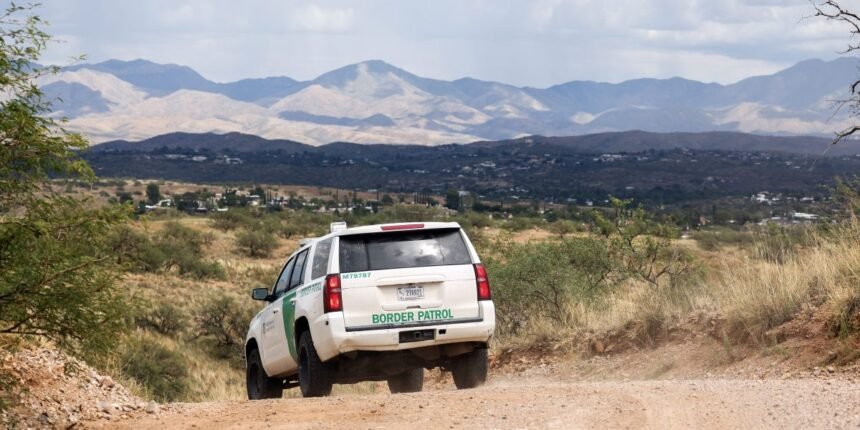
U.S. Border Patrol agents raided a humanitarian aid station in the Arizona desert late last month, taking three people into custody and breaking into a trailer without a warrant.
Video taken by No More Deaths, a faith-based aid group out of Tucson that operates the site, shows agents with flashlights prying open a trailer door and entering the structure. The camp, located just miles from the U.S.–Mexico border, has long been used to provide medical care to migrants crossing one of the world’s deadliest stretches of desert.
Monica Ruiz House, a No More Deaths volunteer who’d recently been involved in deportation defense work in Chicago, said the warrantless raid spoke to a rising culture of lawlessness among the Trump administration’s front-line immigration enforcement agencies.
“There’s this frightening pattern of impunity that’s happening across the country,” Ruiz House told The Intercept, “whether it’s Border Patrol, whether it’s ICE agents,” referring to U.S. Immigrations and Customs Enforcement.
The November raid marks the third time in recent years that Border Patrol agents acting under the authority of President Donald Trump have targeted the remote Arizona site, and the first case in which the agency has entered a structure at the location without a warrant.
According to volunteers, Border Patrol agents claimed they were in “hot pursuit” when they broke into the group’s trailer. Hot pursuit has a particular legal meaning and typically applies in cases where law enforcement attempts to make an arrest, a subject flees into a private space, the opportunity to obtain a warrant is not available, and the risk of further of escape, destruction of evidence, or harm to others is high.
Amy Knight, an attorney who has represented No More Deaths volunteers in the past and is currently providing informal legal advice to the group, said there is no evidence that any of those factors were present in the November raid.
By all appearances, Border Patrol tracked a group of people to an aid camp but made no attempt to arrest them en route. “They were inside of a building on private property, and the agents were able to pretty well surround the place — so if they left, they could catch them,” Knight told The Intercept. “There was no reason why they couldn’t get a warrant.”
“Disappeared”
A handful of Border Patrol vehicles amassed at around 4:30 p.m. on the afternoon of November 23 at the organization’s gate near the unincorporated community of Arivaca, according to a summary of events produced by No More Deaths in the immediate aftermath of the raid.
“United States Border Patrol,” said a voice on a loudspeaker, according to the summary, which was shared with The Intercept. “Come out.”
Volunteers who approached the gate were informed agents had tracked a group of suspected migrants to the location and requested access to make arrests.
Three people were on the property receiving medical care at the time, Ruiz House said.
The volunteers refused access to the camp without the presentation of a signed warrant, the summary said. An hour passed before Border Patrol agents parked at the gate and on a nearby hill entered the property. They made a beeline for a trailer on the property.
“If there are people locked in that trailer that’s a big concern,” one of the agents reportedly said.
Asked about their lack of warrant, the agents replied that they were in “hot pursuit” of suspects, according to No More Deaths, and their warrant exception was authorized by “the U.S.A.” — potentially referencing a call to an assistant U.S. attorney, often referred to as an “A.U.S.A”
“They’ve disappeared into the ICE custody black hole.”
In the past, Border Patrol respected the need to have a warrant before entering structures, said Ruiz House. Customs and Border Protection, the Border Patrol’s parent agency, declined to comment on the agents’ purported justification for entering the aid group’s property.
The first of the three people taken into custody was dragged to a Border Patrol truck as volunteers prayed. No More Deaths has been working to find the arrestees in the weeks since, to no avail. “They’ve somewhat disappeared into the ICE custody black hole,” Ruiz House said. “We’re trying to locate them.”
Years in Trump’s Sights
No More Deaths, also known as No Más Muertes, is the most prominent of several humanitarian aid providers in the Sonoran Desert, offering medical care to migrants for more than two decades in a region that has claimed thousands of lives since the U.S. government undertook a program of intensifying border militarization in the 1990s.
In June 2017, Border Patrol agents staked out the group’s camp near Arivaca for three days during a blazing heatwave. They entered after obtaining a warrant, and approximately 30 agents took four Mexican nationals into custody who were receiving treatment for heat-related illnesses, injuries, and exposure to the elements. The men had been traveling by foot for several days in temperatures exceeding 100 degrees.
The operation marked the beginning of a multiyear campaign by the Trump administration to imprison U.S. citizens involved in the provision of humanitarian aid. In a January 2018 raid at a separate aid station, Border Patrol agents arrested No More Deaths volunteer Scott Warren and two Central American asylum-seekers who’d become lost in Arizona’s ultra-lethal West Desert.
The Trump administration additionally levied federal littering charges against several No More Deaths volunteers for leaving jugs of water on a remote wildlife refuge where the dead and dehydrated bodies of migrants are often found.
Warren was hit with federal harboring and conspiracy charges and faced up 20 years in prison.
The prosecutions became a cause célèbre in Tucson, with yard signs filling residents and businesses’ windows that read “Humanitarian Aid is Never a Crime — Drop the Charges.”
Both cases collapsed at trial, with Warren’s defense attorneys successfully arguing that his volunteerism was the product of deeply held spiritual belief concerning the sanctity of human life and thus protected under the Religious Freedom Restoration Act.
The administration targeted the camp again in 2020, again after No More Deaths released unflattering documents concerning the agency’s operations.
In both 2017 and 2020, the raids targeting No More Deaths were carried out by agents with BORTAC, a specialized SWAT-style arm of the Border Patrol now tasked with carrying out high-profile and controversial arrests in cities far from the U.S.–Mexico divide.
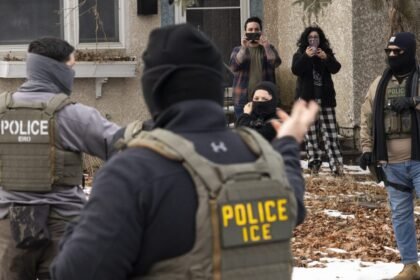
“ICE is increasingly relying on Border Patrol to carry out its internal operations,” said Ruiz House. “Having Border Patrol operate in the interior is absolutely a force multiplier because the fact is ICE simply doesn’t have all the resources to carry out mass deportations, they are going to need other agencies to help them, but there’s also a very big symbolic dimension.”
The green, soldier-like uniforms, she argued, instill a “particular kind of fear” in immigrant communities. It is precisely this externalization of militarized border enforcement that aid groups in the borderlands have been warning about, and Border Patrol leadership have spent years clamoring for.
As one senior agent told the New York Times recently, “The border is everywhere.”