

All France News
Another writer once told me that she never, ever apologizes. How unenlightened and abrasive, I thought at the time. This was circa 2019, when the specter of cancellation loomed large, where old tweets were being dug up, and public apologies abounded.
I like to think we’ve come out on the other side a bit more canny. The era of overcorrection converted me to the idea that, with few exceptions, you should not publicly apologize, and you should not retreat.
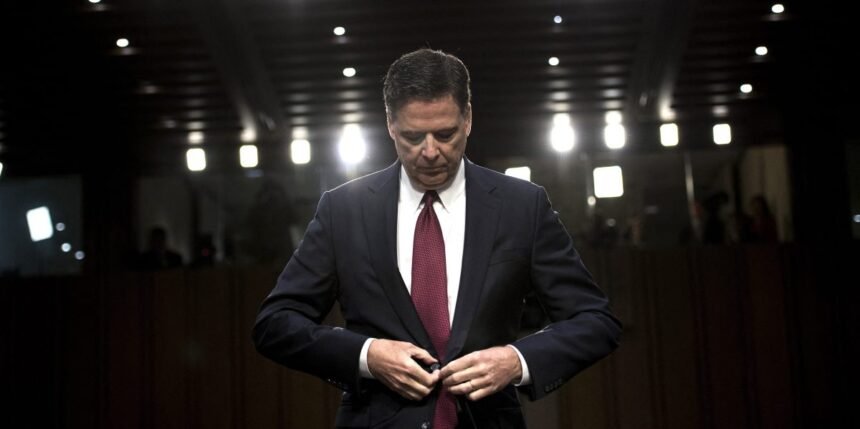
I’ve been thinking about this again in the wake of former FBI Director James Comey’s second indictment stemming from a dumb joke he literally wrote in the sand. While on a beach vacation last year, Comey spelled out the words “86 47” and posted the photo online. For this limp act of resistance, he’s been charged with threatening to kill the president and transmitting the message via interstate commerce, i.e., Instagram.
For those who’ve never worked a service industry job and are not unruly, public drunks — which would make for an interesting Venn Diagram for members of this administration — “86” is slang for removing someone from an establishment. It’s ludicrous to imagine this being read as a threat on Donald Trump’s life, but that was hardly the point.
What matters is that Comey made a critical misstep: He deleted the post and retreated, giving his detractors exactly what they so richly desired. “I didn’t realize some folks associate those numbers with violence. It never occurred to me but I oppose violence of any kind so I took the post down,” he said at the time.
Now, some necessary caveats: There is great value in addressing specific wrongs to the specific people you’ve wronged. This is best done in private. If you find yourself apologizing to a large group of unspecified people for hard-to-pin-down or ever-evolving wrongs, it should give you pause, ditto if you start by opening up your Notes app. Consider who is asking you to apologize and their motivations for doing so. Are they trying to exert control over you? Do they want to gain leverage for future use?
Comey’s de facto apology not only didn’t matter to its intended audience, but it also telegraphed the former FBI director as weak. Announcing himself as willing to capitulate only chummed the water further, the sharks circled, and he bent the knee to the worst actors rather than stand his ground. Deleting the post, in the modern era, ends up looking like an admission of guilt — or, at least, an admission that the bad guys got under your skin, which means they can do so again, at will, in the future.
Once you start apologizing to appease the nameless, faceless ombudsmen looking to catch you out, you might find it’s impossible to stop.
New York City Mayor Zohran Mamdani is experiencing this firsthand. Early in March, the right-wing website Jewish Insider thought they were onto the scoop of the century when they published a story blaring: “Zohran Mamdani’s wife liked social media posts celebrating Oct. 7 attacks.” That premise was hardly borne out by the posts that Rama Duwaji, an interdisciplinary artist, had “liked” — which included such incendiary phrases as “Systemic change for collective liberation” — but the damage was done. A Mamdani spokesperson responded to the report with a conciliatory statement: “Mayor Mamdani has been clear and consistent: Hamas is a terrorist organization, October 7th was a horrific war crime, and he has condemned that violence unequivocally.”
It’s safe to say this apology was not accepted, and bad actors in the media doubled down on attacking Duwaji. One week later, a gotcha reporter manufactured outrage with a story for the conservative Washington Free Beacon about one of Duwaji’s illustrations running alongside a collection of essays edited by Susan Abulhawa about the indignities of living under Israeli occupation — in this case, a Gazan woman’s search for something as simple as a bathroom. The publication attempted to hold Duwaji accountable for everything the editor has ever said, none of which was contained in the piece itself, which was actually written by Diana Islayih.
Mamdani apologized for the editor, saying, “I think that that rhetoric is patently unacceptable. I think it’s reprehensible.” But the mayor’s critics were quick to seize on what was left unsaid, with an Anti-Defamation League leader crediting his apology with one hand while offering with the other: “However, we have not heard from [Duwaji]. Does she have a problem with the author and her statements? We just don’t know.” (Abulhawa, for her part, nailed it in a withering response to Mamdani’s apology: “You succumbed to forces that seek to pick away at you, at your talented, beautiful wife, and at your work, clawing harder with each apology or concession you make.”)
It wasn’t over, and we likely haven’t heard the end of it. The Free Beacon doubled down on its intrepid reporting by advanced-searching up some of Duwaji’s off-color tweets from when she was a teenager. This seemed to break the dam, and New York’s first lady publicly apologized earlier this month in an interview on the art site Hyperallergic.
“I felt a lot of shame being confronted with language I used that is so harmful to others; being 15 doesn’t excuse it,” she told the site. “I’ve read and seen a lot of what others have had to say in response, and I understand the hurt I caused and am truly sorry.”
This all comes after Mamdani was only a few months off his historic win in an election where the most votes were tallied since 1969 — one in which he overcame wave after wave of Islamophobic fearmongering and political opponents smearing him as “antisemtic” for refusing to roll over on supporting Palestinian liberation. He stood up for something people believe in and was rewarded for not backing down, which makes it all the more mystifying that he would start apologizing now.
But Mamdani and Duwaji are far from alone. Years back, Rep. Ilhan Omar was famously disciplined for her “all about the Benjamins” tweet, which suggested, apparently quite controversially, that money was involved in lobbying. (After being tarred as trafficking in antisemitic tropes, Omar tweeted, “I unequivocally apologize.”) The attacks on Omar — again, brought by bad actors — have not stopped since then.
The door on all this apologizing only swings one way. You’ll never get an apology out of Donald Trump, AIPAC, or the vast majority of elected Republicans. This should force you to consider that, just maybe, your opponents weren’t actually offended in the first place; they were exercising power over you in a way you’ve already proven works. It’s akin to political blackmail: If you prove you’re willing to pay the bad guys off once, there’s nothing to stop them coming back again and again for another pound of flesh.
Being involved in public life — and politics in particular — means offending people. It means making enemies of the types of people who strenuously fight against everything you stand for. What the left should stake out is the courage to stand on principle and be willing to have the bad people dislike you. Because without a spine, an elected lefty is just another politician.