

All France News
President Donald Trump talks endlessly of “peace.” He ran for office promising to keep the United States out of conflicts, claims to be a “peacemaker,” has campaigned for a Nobel Peace Prize, and founded a so-called Board of Peace. “Under Trump we will have no more wars,” he said on the campaign trail in 2024. Yet Trump has immersed the U.S. in constant conflict, outpacing even other presidential warmongers like Richard Nixon, George W. Bush, and Barack Obama.
The White House and Pentagon won’t tell the American people where the U.S. is at war, and Trump has never gone to Congress for war authorization. But an analysis by The Intercept reveals that Trump has embroiled the U.S. in more than 20 military interventions, armed conflicts, and wars during his five-plus years in the White House. Due to a lack of government transparency, obscure security cooperation, and carveouts baked into the U.S. Code — like the 127e authority enacted in the wake of the September 11 attacks, and the covert action statute that enables the CIA to conduct secret wars — the actual number could be markedly higher.
During his two terms in office, Trump has overseen armed interventions and military operations — including drone strikes, ground raids, proxy wars, 127e programs, and full-scale conflicts — in Afghanistan, Central African Republic, Cameroon, Ecuador, Egypt, Iran, Iraq, Kenya, Lebanon, Libya, Mali, Niger, Nigeria, North Korea, Pakistan, the Philippines, Somalia, Syria, Tunisia, Venezuela, Yemen, and an unspecified country in the Indo-Pacific region, as well as attacks on civilians in boats in the Caribbean Sea and Pacific Ocean. More than 6,500 U.S. Special Operations forces’ “operators and enablers” are currently deployed in more than 80 countries around the world. And during its second term, the Trump administration has also bullied Panama and threatened Canada, Colombia, Cuba, Greenland (perhaps also Iceland), and Mexico.
Under the U.S. Constitution, it’s Congress that has the authority to declare war, not the president, pointed out Katherine Yon Ebright, counsel in the Brennan Center’s Liberty and National Security Program.
“Congress has not authorized conflicts in this wide array of contexts, and indeed many lawmakers — to say nothing of members of the public — would be surprised to learn that hostilities have taken place in many of these countries,” Ebright said. “Congressional authorization isn’t just a box-checking exercise: It’s a means of ensuring that the solemn decision to go to war is made democratically and accountably, with a clear purpose and goal that the American people can support.”
Despite the fact that the U.S. has not declared war since 1941, its military has fought near-constant wars from Korea to Vietnam from the 1950s through the 1970s to Afghanistan and Iraq in the 21st century, as the executive branch has come to dominate the government and Congress has abdicated its constitutional duty to declare war.
For years, the Pentagon has even attempted to define war out of existence, claiming that it does not treat 127e and similar authorities as authorizations for the use of military force. In practice, however, Special Operations forces have used these authorities to create and control proxy forces and sometimes engage in combat alongside them. Recent presidents have also consistently claimed broad rights to act in self-defense, not only of U.S. forces but also for partner forces.
“Many lawmakers — to say nothing of members of the public — would be surprised that hostilities have taken place in many of these countries.”
The Trump administration has even claimed the full-scale conflict in Iran is something other than what it is. Earlier this month, Undersecretary of Defense for Policy Elbridge Colby refused to call it a war. “I think we’re in a military action at this point,” he told lawmakers.
Trump routinely refers to the conflict with Iran as a war, but he has also cast it as an “excursion.” Trump has also erroneously claimed that if he doesn’t call the conflict with Iran a “war,” it circumvents Congress’s constitutional authority.
“We have a thing called a war, or as they would rather say, a military operation. It’s for legal reasons,” he said on Friday. “I don’t need any approvals. As a war you’re supposed to get approval from Congress. Something like that.”
EArlier This month, Special Operations Command chief Adm. Frank M. Bradley told the House Armed Services Committee’s Subcommittee on Intelligence and Special Operations that secret-war capabilities were key for the United States.
“This environment places a premium on forces capable of operating persistently inside contested spaces, below the threshold of armed conflict,” he said. “Small footprints are necessary to enable denial strategies, strengthen allied resilience, and contribute to deterrence without triggering escalation, and to counter illicit and malign activity without large-scale military presence.”
Bradley claimed America’s enemies “blur the lines between competition and conflict,” but this is precisely what America has done for decades, including numerous secret wars during both Trump terms. The United States has waged unconstitutional and clandestine conflicts through a variety of mechanisms. The covert action statute, for example, provides the authority for secret, unattributed, and primarily CIA-led operations that can involve the use of force. It has been used during the forever wars, including under Trump, to conduct drone strikes outside areas of active hostilities. It was apparently employed in the first U.S. strike on Venezuela in late 2025 — a prelude to a war, days later, that led to the kidnapping of that country’s president, Nicolás Maduro, by U.S. Special Operations forces.
The 2001 Authorization for Use of Military Force, which was enacted in the wake of the 9/11 attacks and has been stretched by successive administrations to cover a broad assortment of terrorist groups — most of which did not exist on September 11 — has been used to justify counterterrorism operations, including ground combat, airstrikes, and support of partner militaries, in at least 22 countries, according to a 2021 report by Brown University’s Costs of War Project.
Under Trump, even this signature post-9/11 workaround for war has been eschewed for something more clandestine. Top Pentagon leadership wanted to keep so-called “advise, assist and accompany” or “AAA” missions — which can be indistinguishable from combat — under wraps during Trump’s first term. This led then-Defense Secretary James Mattis to order U.S. operations in Africa to be kept “off the front page,” a former senior U.S. official told the International Crisis Group.
But the bid to keep Trump’s other African wars secret imploded during a May 2017 AAA mission when Navy SEAL Kyle Milliken was killed and two other Americans were wounded in a raid on an al-Shabab camp in Somalia. The Pentagon initially claimed that Somali forces were out ahead of Milliken — U.S. troops are supposed to remain at the last position of cover and concealment where they remain out of sight and protected — but that fiction fell apart, and the truth emerged that he was, in fact, alongside them.
This was followed by an October 2017 debacle in Tongo Tongo, Niger, where ISIS fighters ambushed American troops, killing four U.S. soldiers and wounding two others. The U.S. initially claimed troops were providing “advice and assistance” to local counterparts. In truth, until bad weather prevented it, the ambushed team was slated to support another group of American and Nigerien commandos attempting to kill or capture an ISIS leader as part of Obsidian Nomad II, another 127e program.
Under 127e, U.S. commandoes — including Army Green Berets, Navy SEALs, and Marine Raiders — arm, train, and provide intelligence to foreign forces. Unlike traditional foreign assistance programs, which are primarily intended to build local capacity, 127e partners are then dispatched on U.S.-directed missions, targeting U.S. enemies to achieve U.S. aims.
During Trump’s first term, U.S. Special Operations forces conducted at least 23 separate 127e programs across the world. Previous reporting by The Intercept has documented many 127e efforts in Africa and the Middle East, including a partnership with a notoriously abusive unit of the Cameroonian military, also during Trump’s first term, that continued long after its members were connected to mass atrocities. In addition to Cameroon, Niger, and Somalia, the U.S. has conducted 127e programs in Afghanistan, Egypt, Iraq, Lebanon, Mali, Syria, Tunisia, Yemen, and an undisclosed country in the Indo-Pacific region.
“During the global war on terror, the Department of Defense built out its capacity, and secured legal authorities, to operate ‘by, with, and through’ foreign militaries and paramilitaries,” Ebright said. “These smaller-scale, unauthorized hostilities through or alongside foreign partners may seem quaint compared to the Iran War and other recent public and persistent hostilities, but for years they deepened the perception that the president may use force whenever and wherever he pleases, even without specific congressional authorization.”
For almost one year, the White House has failed to respond to repeated requests from The Intercept for information about past and current 127e programs.
“While Trump claims to be the president of peace, he is actually the conflict-in-chief, waging many pointless and deadly wars, ensuring generational animosity towards a rogue U.S.,” said Sarah Harrison, an associate general counsel at the Pentagon’s Office of General Counsel, International Affairs during Trump’s first term. “His actions are not just unconstitutional and in violation of international law, they make Americans less safe and their wallets less full.”
During his second term, Trump has made overt war across the African continent, conducting airstrikes from Nigeria to Somalia. In the Middle East, Trump has left a trail of civilians dead, from a migrant detention facility in Yemen to an elementary school in Iran.
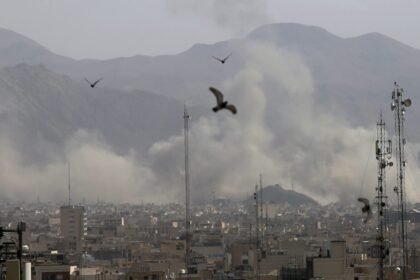
America’s punishing war on Iran has ground on for over a month without a clear definition of victory, a plan for the aftermath, or coherent strategy behind bellicose rhetoric and shifting claims, most recently that the U.S. is fighting a regime change war and will possibly seize Iran’s oil.
“We’ve had regime change if you look already because the one regime was decimated, destroyed, they’re all dead,” Trump said on Sunday, referring to top ranking officials killed in the war including the late Supreme Leader Ayatollah Ali Khamenei. “The next regime is mostly dead.”
“We’ve had regime change if you look already because the one regime was decimated, destroyed, they’re all dead.”
Additional U.S. forces are now being sped to the Middle East to augment more than 40,000 troops already stationed in the region. This included dozens of fighter jets, bombers, and other aircraft, as well as two carrier strike groups. (The USS Gerald R. Ford had to since abandon the fight and travel to port, following a fire on the ship.)
More than 2,000 additional Marines arrived in the region over the weekend, and 2,000 more are on their way by ship. A similar number of paratroopers from the 82nd Airborne Division are expected to arrive soon. The influx of troops comes as Trump has threatened to seize Iran’s oilfields.
The Pentagon has already requested $200 billion in supplemental funds to pay for the Iran war, and the ultimate cost is expected to run into the trillions of dollars.
The U.S. is also ramping up conflicts in the Western hemisphere. Since attacking Venezuela and abducting its president in January, the U.S. has reportedly undertaken a regime-change operation in Cuba, attempting to push out President Miguel Díaz-Canel. Trump has also repeatedly spoken of “taking” Cuba. He has also threatened to annex Greenland (and possibly Iceland), turn Canada into a U.S. state, and carry out military strikes in Mexico.
The chief of U.S. Special Operations Command recently referenced the “perceived increase of U.S. support to counter-cartel operations in Mexico” and said his elite troops “remain postured to provide… support to Mexican military and security forces to dismantle narco-terrorist organizations.” The U.S. claims to be currently at war with at least 24 cartels and criminal gangs it will not name.
Under Operation Southern Spear, the U.S. has conducted an illegal campaign of strikes on boats in the Caribbean Sea and Eastern Pacific Ocean, destroying 49 vessels and killing more than 160 civilians. The latest strike, on March 25 in the Caribbean, killed four people.
“Trump wants to call DoD’s summary executions on the high seas a war because he thinks that will allow him to kill civilians. And he wants to call the war in Iran a military operation so he doesn’t have to go to Congress for approval,” explained Harrison, who also previously served in the White House Office of Legislative Affairs. “It doesn’t matter what imaginary legal constructs Trump comes up with, it won’t protect him or his officials from accountability for these undeniably illegal uses of force.”
The boat strikes recently moved to land as so-called “bilateral kinetic actions against cartel targets along the Colombia-Ecuador border” on unnamed “designated terrorist organizations.” “The joint effort, named ‘Operation Total Extermination,’ is the start of a military offensive by Ecuador against transnational criminal organizations with the support of the U.S.,” Joseph Humire, the acting assistant secretary of war for homeland defense and Americas security affairs, announced earlier this month. That U.S.–Ecuadorian campaign has already strayed into Colombia after a farm was bombed or hit by “ricochet effect” on March 3, leaving an unexploded 500-pound bomb lying in Colombia’s border region.
“It doesn’t matter what imaginary legal constructs Trump comes up with, it won’t protect him or his officials from accountability.”
Harrison drew attention to the human costs of the raft of conflicts being waged by the Trump administration, remarking on “all the people who are needlessly dying because of one man’s ego and how it makes the U.S. much less safe.”
“The proliferation of unauthorized, presidentially initiated conflicts raises profound challenges for our rule of law, democracy, and accountability around matters of war and peace,” said Ebright. “This is true, too, of secret wars that government officials may refer to as ‘light-footprint warfare’ or ‘low-intensity conflict,’ not the least because we’ve repeatedly seen intermittent strikes or raids give way to protracted military engagements and larger-scale operations.”
Bradley — perhaps best known for ordering the double-tap strike that killed two shipwrecked men last fall — recently offered a murky catalogue of “state adversaries, terrorists, and transnational criminal networks” aligned against the United States, including China, Russia, “Iran, its proxy forces, and terrorist organizations,” and other unnamed “state adversaries”; transnational criminal organizations that “continue to attempt to exploit the southern approaches to the United States”; ISIS and Al Qaeda affiliates; as well as “terrorists” and “extremist groups” in Africa. The State Department currently counts 94 foreign terrorist organizations around the world, including 13 that were designated back in 1997. Thirty-seven groups, about 40 percent of the list, were added under Trump — 27 during his second term. The most recent addition, the Sudanese Muslim Brotherhood, was designated earlier this month. The administration also maintains a secret list of domestic terrorist organizations which it will not disclose.
For weeks, The Intercept has asked if the White House even knows how many wars, conflicts, kinetic operations, and military interventions the U.S. is currently involved in. We have never received a response.