

All France News
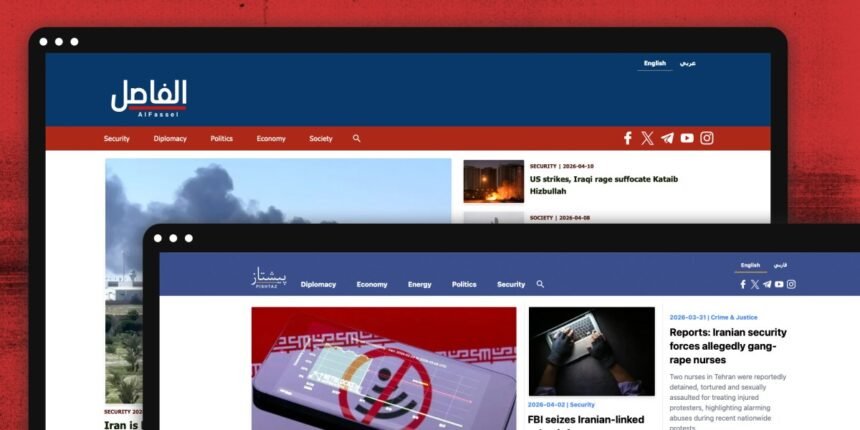
Al-Fassel and Pishtaz News look like typical news websites. They have neatly designed homepages and active social media accounts, where they share reporting and videos on Middle Eastern geopolitics in Arabic and Farsi, respectively, as well as English. Al-Fassel’s X account states the publication’s mission is “to investigate events of great significance that are often overlooked by local and regional media, and to shed light on them.” The Pishtaz News X account says it was established “to investigate and expand upon important news that local and regional media often overlook.”
These overlooked stories share the same ideological slant and editorial voice: that of the White House. Al-Fassel’s YouTube account, for instance, has racked up millions of views on Arabic-language videos praising the Trump administration’s Gaza policy and exhorting Hamas to cease “taking orders from the Iranian regime” and release Israeli prisoners. On Pishtaz News, a poll on the homepage recently asked: “[H]ow would you describe your belief about the Supreme Leader’s current health status and whereabouts?” Possible answers range from “In good health but hiding” to “Disfigured” or “Dead.” The excellence of Saudi and Emirati leadership, both close military partners of the U.S., is a recurring theme.
Disclosed only at the bottom of both sites behind an “About” link that is easily missed by casual readers, the outlets note that they are “a product of an international media organization publicly funded from the budget of the United States Government.” The government affiliation remains undisclosed on social media platforms including Instagram, despite a platform policy requiring the labeling of state-backed media outlet to prevent the unwitting consumption of government propaganda.
The sites’ recent fixation on crushing Iran is unlikely to be a coincidence: Both publications share numerous connections with a portfolio of fake newsrooms that originated as a military psychological operations campaign against foreign internet users.
Al-Fassel and Pishtaz News did not respond to requests for comment, nor did CENTCOM or the Department of Defense.
In 2008, U.S. Special Operations Command put out a call for contractors to help operate what it called the Trans-Regional Web Initiative, a project that would provide “rapid, on-order global dissemination of web-based influence products and tools in support of strategic and long-term U.S. Government goals and objectives.” In other words, state propaganda pushed by Pentagon.
Masquerading as independent online newsrooms, the TRWI sites hired “indigenous content stringers” to produce articles “which Combatant Commands (COCOMs) can use as necessary in support of the Global War on Terror.” The contract, awarded to General Dynamics Information Technology, spawned 10 websites that funneled U.S. foreign policy talking points to audiences across the Middle East and South Asia, running everything from banal essays about inter-faith coexistence to, as reported by Foreign Policy in 2011, articles intended to “whitewash the image of Central Asian dictatorships.” By 2014, the sites were deemed a failure by Congress and de-funded.
Eight years later, a team of researchers published an unusual report. Following the 2016 election, the bulk of the Western media’s interest in online propagandizing had focused on influence campaigns attributed to Russia, China, and other American geopolitical rivals. But the 2022 report from the Stanford Internet Observatory and Graphika, a commercial internet analysis firm and Pentagon information warfare contractor, uncovered a network of phony “pro-Western” Twitter and Facebook accounts that pushed articles from pseudo-news websites. The report stopped short of formally attributing the campaign to the U.S., but noted that both Meta and Twitter had done so. The researchers concluded that the accounts in question attempted the coordinated spread of articles from a network of sham news websites established by U.S. Special Operations Command.
The report found that just a few years after TRWI’s ostensible death, many of the sites had simply rebranded, now carrying hard-to-find disclosures mentioning they were run by U.S. Central Command. Following Stanford and Graphika’s findings, some of the sites shut down; others continued. Subsequent reporting by the Washington Post found that the embarrassing revelations spurred the Pentagon to conduct “a sweeping audit of how it conducts clandestine information warfare.”
A review of the Internet Archive shows that in the aftermath of the Stanford report, TRWI sites that remained in operation changed their disclosure language. Rather than citing CENTCOM sponsorship, these sites shifted to state that they are “publicly funded from the budget of the United States Government.” The disclosure language used by the remaining network of CENTCOM propaganda sites is a word-for-word copy of the phrasing The Intercept found tucked away on the About pages of Pishtaz News and Al-Fassel.
That’s not the only evidence suggesting a link to this network of military propaganda sites.
Since they began publishing in 2023, Al-Fassel and Pishtaz News have regularly quoted or summarized CENTCOM press releases touting regional operations and battlefield successes, as did the outlets mentioned in the Stanford/Graphika report. The reliance on combatant command press releases in particular is an editorial strategy that dates back to the original SOCOM-run TRWI network.
On X, Pishtaz News follows only three other users; two are the official CENTCOM accounts for Farsi and Arabic audiences. The Pishtaz News Instagram account, which carries no disclosure of the account’s governmental nature, follows only one other user: “US CENTCOM FARSI.”
Intentionally or otherwise, Al-Fassel’s posts to X are often geotagged as having been sent from Lutz, Florida, a stone’s throw from the headquarters of CENTCOM and SOCOM in Tampa, as well as myriad military contractors that service both.
Both sites also share common design elements with the TRWI-associated publications that suggest they were created or operated by the same contractor: All posts conclude with a poll asking “Do you like this article?” using the same thumbs-up and thumbs-down icons. URLs are structured identically for Al-Fassel, Pishtaz News, and Salaam Times — an Afghanistan-focused site launched under the TRWI that continues today under a different name — suggesting they were coded using the same tools. The three sites use an identical 404 error graphic to alert users when they’ve clicked on a broken link, as well.
The web design of Al-Fassel and Pishtaz News — including page layout, URL structure, 404 error graphic, and much of the legal verbiage in the About sections — closely mirrors that of CENTCOMcitadel.com, a publication with similar content that carries an overt disclosure of Pentagon sponsorship at the bottom of its homepage.
“These sites are similar in style to the overt messaging efforts we saw from the Department of Defense previously.”
“These sites are similar in style to the overt messaging efforts we saw from the Department of Defense previously,” Renée DiResta, a former Stanford researcher and co-author of the 2022 report, told The Intercept. “We previously saw this pattern of clearer U.S. affiliation language in the About page of the domain, then minimal to no acknowledgement on the social media profiles.”
There are other subtle nods to the sites’ true purpose: URLs for the English language versions of each site are denoted “en_GB,” for Great Britain. In a comprehensive 2015 analysis of the TRWI network, University of Bath doctoral student Roy Revie observed that the network of American military propaganda sites explicitly marked their English versions as British because “SOCOM seeks to avoid any suggestion its sites are aimed at US audiences.”
In the parlance of information warfare, these propaganda shops are considered “overt” rather than “covert,” because their state ownership is technically disclosed. But in his 2015 paper, Revie argued that these psyop sites still engage in deception. They use online journalism as a form of camouflage, he wrote, because most readers won’t seek out a publication’s About page to learn about its funding. The design of these sites “allows the DOD to credibly claim full transparency and maintain legitimacy, putting the onus onto the user to inform themselves about the source,” Revie wrote.
The output of both sites consistently lionizes the U.S. and Israel, along with America’s Gulf allies. They regularly demean the Iranian state, presenting a wholly lopsided and misleading account in a time of war. “The US says it does not seek open conflict with Tehran,” reads a March 2 article in Al-Fassel. Both sites have repeatedly cited reporting by Iran International — a Saudi-funded, pro-Israel, Iranian monarchist publication with a long record of journalistic misrepresentation. A March 31 Pishtaz News article, for instance, based on an entirely anonymously sourced Iran International post, alleged that Iranian security forces gang-raped nurses in Tehran.
Experts told The Intercept the newscaster was likely a product of generative AI and not genuine footage.
Some articles deeply misstate or misrepresent the facts. An April 15 Al-Fassel article about Iran’s “war crime threats” against the American University of Beirut omitted the fact that these threats came in response to repeated U.S.–Israel airstrikes against Iranian schools. The day after an Al-Fassel article described the Houthis as “crippled” and “largely disintegrated,” capable of offering only “verbal support” for Iran, the Yemeni militant group launched cruise missiles at Israel.
The outlets also illustrate the extent of deceptive messaging radiating from the Pentagon and White House: A March 5 post to the Pishtaz News Instagram account boasted, “The Iranian regime’s ability to strike US forces and regional partners is rapidly eroding, while US combat power continues to grow.” Four weeks later, Iran was continuing to lob missiles at U.S. bases as well as its regional partners, and succeeded in downing an American F-15 and A-10 Warthog. An April 4 Al-Fassel Instagram post claimed, citing Secretary of State Marco Rubio, that “Iran is not satisfied with a peaceful nuclear program, but seeking to enhance its military capabilities,” even though a 2025 assessment from the Office of the Director of National Intelligence concluded the opposite.
“You will be systematically annihilated.”
Other articles dispense with masquerading as journalism, reading more as warnings straight from Washington: “United States is fully prepared to protect its forces in Middle East,” read a June 2025 headline on Pishtaz News. “With advanced technological capabilities and highly-trained personnel, the United States maintains one of the world’s most capable military forces, continuously adapting to evolving security challenges to maintain order and stability.” A March 27 Pishtaz News tweet was more straightforward. “You will be systematically annihilated,” it threatens in Farsi. “Your commanders are hiding in bunkers. They have sent their families and wealth abroad—why are you still fighting for them?”
Some articles purport to include comments from genuine expert sources. In at least one case, this happened without the knowledge of the source. A July 2025 article in Al-Fassel predicted that a future closure of the Strait of Hormuz “would harm China and Russia more than other nations.” The article quoted Umud Shokri, an energy analyst affiliated with George Mason University, the State Department, and the Middle East Institute. “I would like to clarify that I was not aware of any affiliation between alfasselnews.com and the U.S. government,” Shokri told The Intercept. “I also did not have any direct interview with the platform, nor was I contacted by them directly. To the best of my knowledge, any quotation attributed to me appears to have been drawn from prior public commentary or other media appearances.”
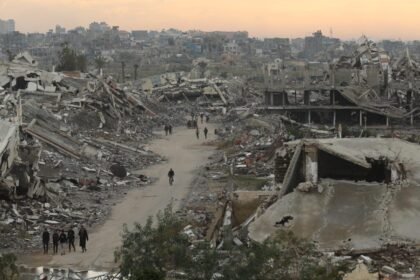
Prior to the war on Iran, a top priority on both sites was marketing the U.S.–Israeli plans for the future of Gaza. The message is essentially a distillation of the U.S.–Israel–Gulf State consensus: That all Palestinian suffering is brought on by Hamas rather than the past three years of Israeli bombardment, and that the Trump-sponsored “Board of Peace” augurs an unprecedented era of prosperity for Palestinians.
“The incoming Board of Peace,” a December 2025 Al-Fassel piece claimed, “is expected to foster conditions for democratic representation and meaningful civic participation.” A December 12 Al-Fassel YouTube video similarly blamed Hamas and Iran, rather than Israel, for the blockade of humanitarian aid into Gaza, followed by an AI-generated image of a science fiction city overlaid with Arabic captions promising billions in foreign investment and economic revitalization for Gaza. The video currently has nearly 1.7 million views.
Other items around Gaza further invert reality. Since October 2025, Gaza has been bifurcated by the so-called “Yellow Line,” an arbitrary boundary behind which Israeli forces nominally withdrew last year. Palestinians on the Israeli side of the line face harsh occupying military governance, while those on the other side risk being killed.
Despite claims by Al-Fassel’s video team that Trump’s Gaza policy will herald the ability for countless Palestinians to return home, Israeli forces routinely fire at civilians approaching this buffer zone.
“Incidents of gunfire, shelling, and limited incursions have continued near the ‘Yellow Line,’ the separation zone near the border with Israel, keeping any return highly dangerous,” according to a United Nations video report. “With the amount of available space shrinking, thousands of families have been forced to return to the edges of their destroyed neighborhoods near the ‘Yellow Line,’ despite what residents say is the continued risk of injury or death from intermittent fire.”
Not so, says Al-Fassel: “The Yellow Line is more than a boundary; it is a lifeline designed to keep Gaza’s families safe and informed during the ceasefire,” claimed a November article. “The Yellow Line is not a symbol of division — it is a lifeline.”

Following the 2016 election and the panic surrounding Russian covert propaganda efforts, major American social media platforms began adding labels to the accounts of government-controlled media properties. Videos from Al Jazeera English’s YouTube account, for instance, come with a disclaimer that “Al Jazeera is funded in whole or in part by the Qatari government.” Although X abandoned this policy in 2023, it is still nominally on the books for both Meta, which owns Facebook and Instagram, and YouTube.
There is no disclosure, however, in the Instagram posts or accounts of Al-Fassel or Pishtaz News. YouTube videos from both accounts do not include a disclaimer about U.S. funding; however, a brief disclosure can be found on their main account pages, tucked into an About section that must be expanded to be read.
Neither site appears to have a particularly large audience on social media. Both have paltry followings on X — about 2,400 for Al-Fassel, and only 132 following Pishtaz News — with many appearing to be spam-based accounts with names followed by a long string of numbers that engage in posting behavior common to spam networks. Al-Fassel has found modest engagement on Instagram, where it has over 7,700 followers. Though Pishtaz News has only 475 followers on Instagram, its posts sometimes break through; a March 18 post of CENTCOM footage from the deck of an aircraft carrier, for example, racked up more than 1,100 likes.
At times, the content published by the propaganda sites may have reached American audiences. A March 27 Al-Fassel story alleging the total collapse of the Iranian-led “Axis of Resistance” was shared that same day to FreeRepublic, the conservative American message board, by user MeanWestTexan. Federal law forbids Pentagon propaganda aimed at Americans, though a similar prohibition aimed at the State Department was overturned in 2013.
Sometimes their stories reach other Western readers. An Al-Fassel article on the Houthis made its way into the citations of a 2024 article in the academic journal Survival: Global Politics and Strategy by University of Ottawa professor Thomas Juneau. (Juneau did not respond to a request for comment.) A submission to the U.N.’s Committee on Enforced Disappearances from Justice for All International, a Swiss-based nonprofit, similarly cited an Al-Fassel post on the IRGC, while an annual report by the state-operated Swedish Defence Research Agency relied in part on an Al-Fassel article on ISIS. The Intercept reviewed multiple entries on Grokipedia, X’s Wikipedia clone, citing Al-Fassel articles as well.
Emerson Brooking, a fellow with the Atlantic Council’s Digital Forensic Research Lab and former Pentagon cyber policy adviser, believes CENTCOM is most likely behind the sites and considers their overall reach lackluster. When it comes to online propaganda, he said, the U.S. “could learn some lessons from Iran.” Iranian propaganda efforts — mostly quickly produced AI slop — have captured the attention of the internet in a way that the U.S. ersatz newsrooms have not.
But the sites’ limited reach is unlikely to bring them to a halt anytime soon. Even as the Trump administration has gutted Voice of America and other long-standing tools of U.S. soft power, these sites have continued publishing. If their similarities to the long-running American military psyops are more than coincidental, that says more about a culture of inertia at the Pentagon than its success in winning hearts and minds. Brooking told The Intercept that because operating blogs amounts to a “rounding error” within the broader defense budget, such projects can continue with little scrutiny.
A seldom-read network of propaganda sites might seem to have little purpose. But it’s the kind of thing authorities can gesture toward, Brooking said, when pressed about their efforts to combat Iran in the “information space.” “Successive SOCOM or CENTCOM or other senior leaders could point to the fact that they’re maintaining this network of websites,” he said.